

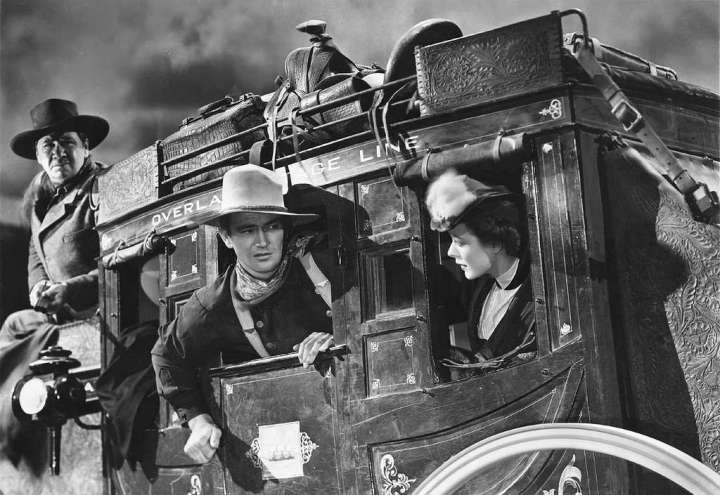
For most people, the Western genre is synonymous with Clint Eastwood. But before him, there was John Wayne. Over a career spanning 5 decades, John Wayne acted in some of the finest Westerns of all time – The Searchers, Rio Bravo and The Man Who Shot Liberty Valence. But the movie that brought him fame and made him a household name was Stagecoach. And it was directed by none other than the legend John Ford. In fact, after this first film together, they formed a lasting partnership and went on to make another 13 movies together. (most of them Westerns). John Wayne had starred in several movies before this one, but none of them was a box office success. In fact, Claire Trevor (who gets the top billing here) was a bigger star at the time….and what a time it was! The year 1939 (when this movie came out) is considered to be the pinnacle of the Golden Age of Hollywood and for good reason.
Comments:
The movie is set in the Wild West (Arizona – New Mexico border) some time in the late 19th century when stagecoach journeys were commonly undertaken to travel between towns. The only place where we get to see a stagecoach these days is on the logo of Wells Fargo bank. In fact, the bank’s name features on a safe box in the early part of the movie. And of course, since this is how money travelled across towns, there was always the threat of gangsters and native Americans. The movie was one of the first ones to feature a group of disparate strangers coming together on a journey. The motley crew includes a US Marshall, an outlaw, a prostitute, the pregnant wife of an American soldier, a gambler, a banker, a whiskey salesman and a drunk doctor. Although they begin the journey from Tonto, AZ to Lordsburg, NM as relative strangers harboring prejudices against each other, the events over the next couple of days cause their initial apprehensions to be replaced by a common bond uniting them against their common enemy – the Apaches.
Speaking of Apaches, we must realize that this movie is a product of its time. The movie is set in post Civil War America and things were very different when it came to people’s sensibilities towards other races and especially native Americans. In their bid to extend the American nation from the Atlantic to the Pacific, the ‘settlers’ were perpetually at war with the natives. No doubt they struck political alliances with local tribes as it suited their needs, but overall, native Americans were looked upon as enemies and barbarians. There’s a mildly amusing moment in the movie when the timid Mr. Peacock (or it is Hancock?) freaks out upon seeing a native woman, only to realize that she’s the wife of their inn-keeper host.
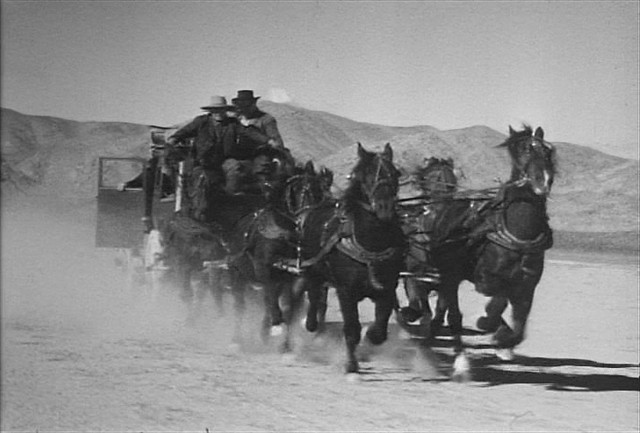
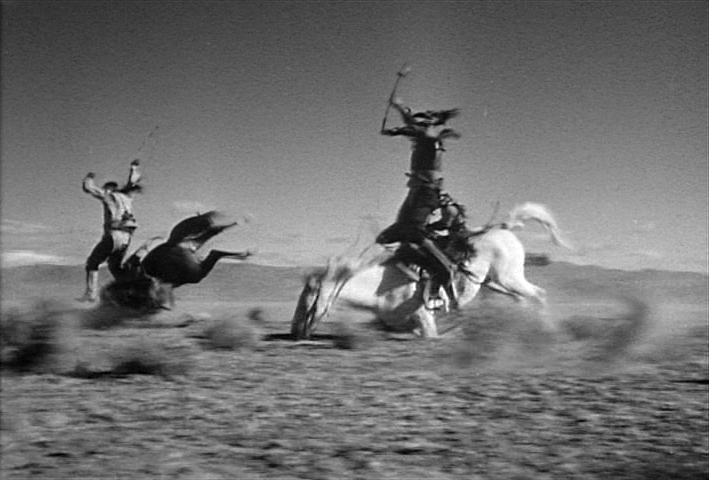
The whole movie builds towards the inevitable ending where the stagecoach is attacked by the Apaches. The ensuing fight has been shot brilliantly in the movie. The stunt coordinator Yakima Canutt – who also doubles up as John Wayne’s stunt double – has done an exceptional job. The sequence where the stagecoach has to cross the river is especially memorable since real horses were used (pre visual effects era). Sadly, real horses were also used to film the sequences where their Apache riders are shot and fall off. Strong, stretchable wires were used to trip the horses to coincide with their rider’s fall and this resulted in many horses being killed or at least with broken limbs after the fall. Remember that these were the days without American Humane society and PETA monitoring the sets. This inhumane method was stopped in later years due to public outcry. This cruelty aside, the climax is one of the most thrilling ones captured on film. It does remind me a little of the chariot race of Ben Hur.
Cast and Crew:
John Ford, a winner of 4 Best Director Oscars, is at the top of his game here. Although, he did not win an Oscar for this movie (beaten by ‘Gone with the Wind’), he followed it up with 2 consecutive wins in 1940 and 1941.
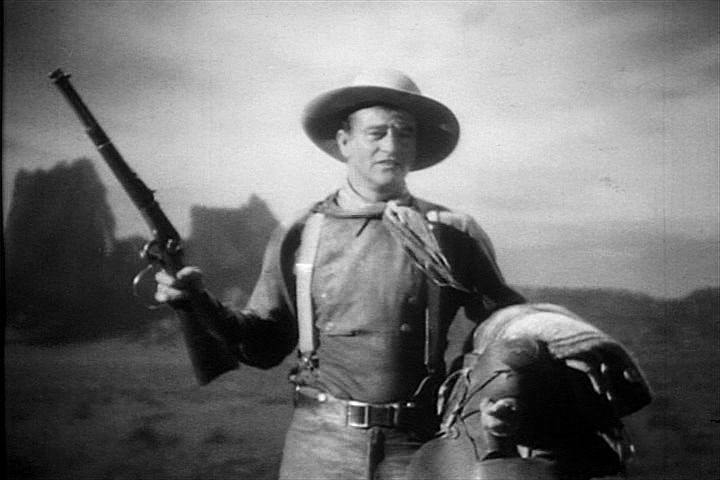
John Wayne got his big break with this movie – the 80th of his career – as Ringo kid. He acted in over 80 Western films and went on to successfully define the Western film genre. To this day, he is the only actor to have an airport named after him (Orange County Airport in Southern California).
Fun Fact: The Ronald Reagan National Airport in Washington D. C. was named to commemorate Ronald Reagan the President and not the actor.
All other actors also give a solid performance. However, a special mention must be made of Thomas Mitchell who won an Oscar for Best Actor in a Supporting Role for playing a drunken doctor – something that became a cliché for several years to follow. Coincidentally, he also featured in several other landmark movies in the same year! – Mr. Smith Goes to Washington, The Hunchback of Notre Dame, and in Gone with the Wind as Scarlett O’Hara’s father.
Final Thoughts:
With its gripping action sequences, this movie is known for carving out a niche identity for the ‘Western’ genre and also giving it one of its most enduring and endearing stars in John Wayne. In spite of some obsolete viewpoints, this remains a must watch movie. It still stands the test of time and shines on par with the other landmark movies of 1939.
 Lights Camera Action
Leave a comment