

There’s a seemingly odd line in the movie ‘Shakespeare In Love’ when the character of Lady Viola De Lesseps asks William Shakespeare whether he “is the author of the plays of William Shakespeare”. This, in fact, is a light-hearted reference to a recent debate that questions how much of Shakespeare’s work was his own. But make no mistake, its intent is not to question the talent of the most famous poet and playwright in the English language. In fact, plenty of references to the plays of Shakespeare and acknowledgements to his contemporaries abound in this wonderful comedy by director John Madden. Of course, the movie takes a lot of artistic liberties too. There was no Lady Viola De Lesseps and the chief influence behind Romeo and Juliet was a poem by an English poet – Arthur Brooke – which itself was based on an Italian tale. And I am no Shakespearean or Elizabethan expert, but chances are that Queen Elizabeth I did not have the sense of humor of the character played by Dame Judy Dench (more on this later).
The movie begins in London of 1593 with Shakespeare having a writer’s block and unable to come up with any good ideas for his next play which is supposed to be a comedy – named ‘Romeo and Ethel, the pirate’s daughter’ for the time being. The playhouses insist on comedies since they are in demand. In fact, action-comedies featuring a few fights and mistaken identities are loved by the audiences – including Queen Elizabeth I herself. She is shown thoroughly enjoying scenes where people are bitten by a dog and sleeping through the boring romantic bits. As it happens, this whole mediocrity has seemingly disillusioned our protagonist William Shakespeare and he has lost his inspiration. But a tryst with Lady Viola De Lesseps, who’s a fan of stage plays in general and his in particular, ignites his passion for her and the theater and what results is the immortal play of ‘Romeo and Juliet’.

The play takes shape as the romance between Lady Viola, daughter of a wealthy, upper-class merchant, and Will, a poor playwright, blossoms, The fact that Viola is already slated to be married to Lord Wessex and move to Virginia and Will is married with his wife and children away at Stratford-upon-Avon is not a deterrent to the star-crossed lovers. Add to it the minor complication of the prevalent belief that playhouses are not a place for well-born ladies to be seen. So to fulfill her passion of acting in theater, Lady Viola is forced into appearing in the play as a man – Thomas Kent – unbeknownst to anyone but Will. Will incorporates all of the couple’s trials and tribulations into the play, which although started out as a comedy, but has now morphed into a romantic tragedy – aptly called ‘Romeo and Juliet’. The writer’s block is finally gone and words which show its audience the true nature of love, flow from Shakespeare’s pen.
Comments:
Although based in the Shakespearean era, the language of the movie is contemporary and hence simple to understand. The irreverent, very 20th-century like humor used in the movie is in stark contrast to its period setting but it works beautifully in the context. When Will Shakespeare utters his first lines in the movie “Doubt thou the stars are fire, doubt thou the sun doth move”, Henslowe replies with a simple “Talk prose”. Imelda Staunton’s nurse taking every precaution to preserve Lady Viola’s virtue, Tom Wilkinson’s moneylender preparing to play the vital role of the apothecary, Henslowe’s stuttering tailor getting a role in the play because Henslowe has ‘a few debts here and there’ are just a few of several funny themes and storylines which add to the subtle humor of the movie. While taking artistic liberties, there are a few characters in the movie which are real. Christopher Marlowe, a competing playwright was a legend of the times, seemingly influencing Shakespeare’s early works. Richard Burbage was a real actor on the London theater scene and the young boy with love of violence is John Webster, who grew up to become an accomplished playwright himself known for plays like ‘The Duchess of Malfi’ indulging in darker themes. The beginning of the movie shows Shakespeare throwing pieces of paper onto things like a skull (Hamlet) and a casket (Merchant of Venice) as reference to his other plays, while the ending creatively leads us into Shakespeare’s famous romantic comedy – Twelfth Night. Finally Lord Chamberlain’s men was a real acting troupe in London.
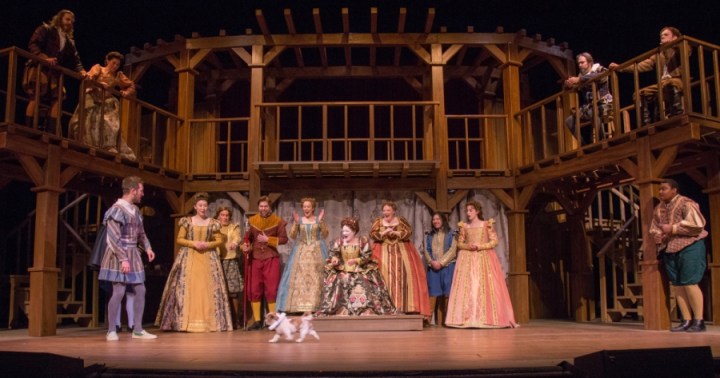
May it be fact or fiction, the liberties taken by the writers of the movie work wonderfully well because it’s not a Shakespeare’s biopic. Very little details are known about some parts of Shakespeare’s life and it is fun to imagine Elizabethan England in the way it’s shown in the movie for a little while.
Cast and Crew:
Let’s start with the acting. Joseph Fiennes as Will Shakespeare and Gwyneth Paltrow as Lady Viola De Lesseps are excellent and very likable. They both exude the charm, passion and despair needed for their roles. Gwyneth Paltrow won the Academy Award for Best Actress over heavy favorite Cate Blanchett (incidentally for the portrayal of Queen Elizabeth I – same role played by Miss Dench).
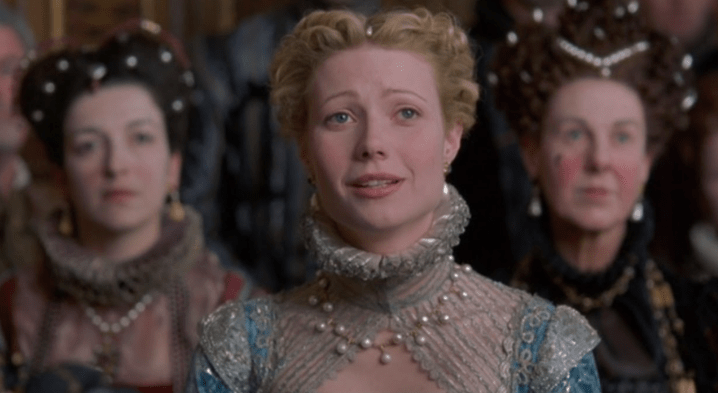
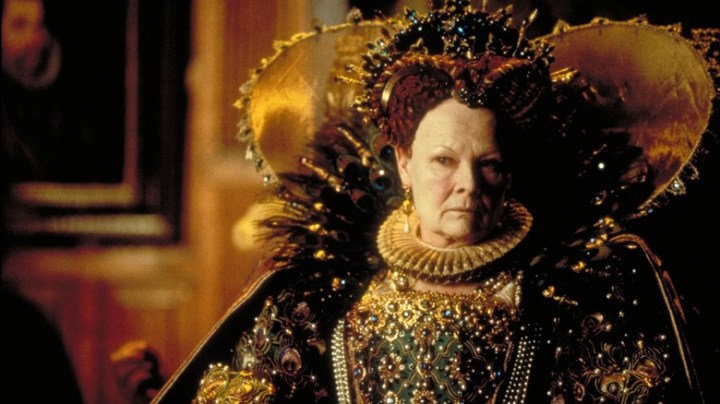
The supporting cast is equally wonderful. Geoffrey Rush as the street-smart Philip Henslowe, ‘a businessman with a cash flow problem’ and Tom Wilkinson as Mr. Fennyman, the shrewd moneylender and Henslowe’s nemesis, both show great comic timing and have several funny lines. Martin Clunes plays the competing theater actor Richard Burbage, and Ben Affleck plays Ned Alleyn, a superstar of the times, as part of Lord Chamberlain’s Men acting company, rounding up the theater folk. Colin Firth plays Lord Wessex in his own inimitable clumsy manner. The real-life couple of Imelda Staunton (Prof. Umbridge of Harry Potter fame) and Jim Carter (Carson of Downton Abbey fame) essentially play the same character of Lady Viola’s nurse off-stage and on-stage respectively and are both hilarious in their versions. But the best cameo is reserved for Dame Judy Dench as Queen Elizabeth I. She is on the screen for a total of just 8 minutes across three scenes but towers high over every frame. The performance is so remarkable that it won the Academy Award for Best Actress in a Supporting Role – the second shortest performance ever to win an award.
Mark Norman and Tom Stoppard received an Academy Award for their impeccable script. And to top it off, the movie won the Best Picture Award (although in a huge controversy) over the heavy favorite ‘Saving Private Ryan’. These were just some of the 7 total Academy Awards won by the movie.
Final Thoughts:
Strong acting, script and direction. Delightful romantic comedy.
 Lights Camera Action
Leave a comment