

There is a famous quote attributed to to Eleanor Roosevelt – “Great minds discuss ideas, average minds discuss events, small minds discuss people.” This theme of great minds discussing ideas is evident in the French director Eric Rohmer’s brilliant movie “My Night At Maud’s”. Mr. Rohmer who is an influential name of the ‘French New Wave cinema’ (french : La Nouvelle Vague) movement directs this evocative masterpiece that forms the fourth installment of his well-known sextet ‘Six Moral Tales‘. In this series of movies that is based on his own essays, Rohmer explores the idea of a man being tempted by another woman but eventually returning back to the first woman that he loves.
The New Wave was an influential movement in French cinema that occurred between the late 1950s and late 1960s. The movement was characterized by innovative filming methods and its focus on technique over style. Often limited by lower budgets in a changing era post the Second World War, the directors had to resort to limited studio settings. With imaginative camera angles, deep character studies and its penchant for challenging established social and moral codes, it captured the audience’s attention. From its collaborative beginnings, when some of its most influential names like Jean-Luc Godard, François Truffaut and Eric Rohmer himself worked together as reviewers / editors for the French film magazine ‘Cahiers du cinéma’, this movement exploded and became popular across Europe and the rest of the world. Mr. Rohmer went on to direct over 50 movies across 5 decades. Arguably his finest work, ‘My Night at Maud’s’, was the movie that catapulted him to fame across the pond in America.
Comments:
This is a movie that is heavy on both ideas and dialogue. The protagonist of the movie is Jean-Louis, an engineer who dabbles in mathematics and the work of Blaise Pascal in his spare time. We are introduced to him while he is attending a church sermon – shown in an extended scene – seemingly to reinforce his devout Catholic views. His friend Vidal is a professor of Philosophy and a communist. The two friends end up spending an evening at Vidal’s friend Maud’s house. Maud, a divorcée with a young daughter, is a free thinking pediatrician. The deep, honest and intimate conversations, which unfold over the evening have a power to change the course of Jean-Louis’ life. This forms the crux of the movie.
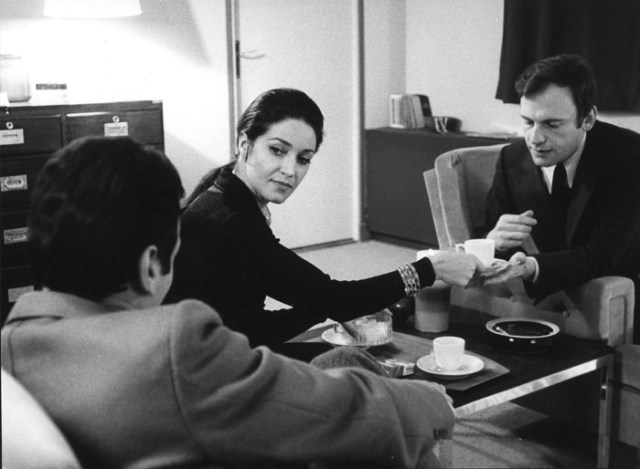
The movie appeals to the intellect of the viewer. All three friends are intellectuals who come from very disparate belief systems. Moreover, Jean-Louis is meeting Maud for the first time in his life. A series of articulate and deeply personal conversations provides a window into their personalities. Over dinner and several cigarettes, the three friends discuss a wide range of topics like philosophy, religion or the lack thereof, nature of relationships between men and women, marital fidelity etc. Very often, the teachings and musings of Pascal feature into their discussions. While one may find it difficult to do so, Jean-Louis has been able to reconcile his scientific and analytical reasoning ability with his devout Christian beliefs. This forms a jumping-off point for many an interesting conversations. What is refreshing to see is the mutual respect that is shared by these characters with diametrically opposite views on certain topics. This free flowing exchange of thoughts occurs very naturally in the movie, just like it would between old friends.
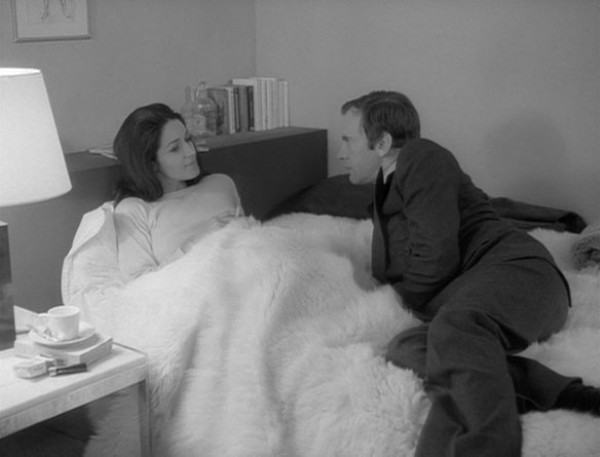
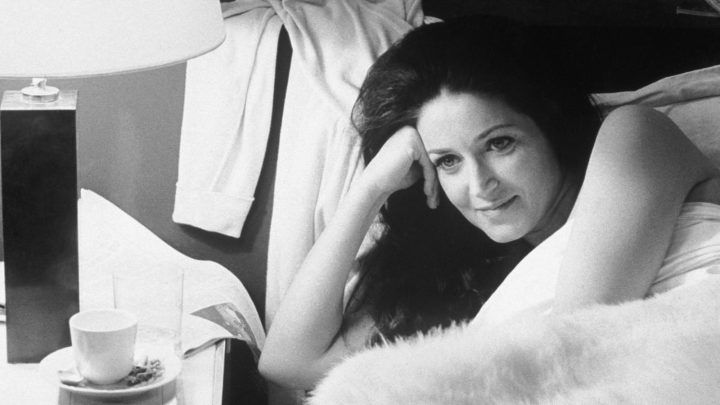
As the evening progresses into night, the discussion steers towards the nature of love and what it means to be loyal in a marriage. I especially liked the way Jean-Louis’ character is averse to a divorce, not because of his Christian beliefs as one would assume, but because of his calculation of probability of a successful marriage with an implicit reference to the Pascal’s triangle that is heavily discussed earlier in the movie. Through all the banter and discussion, there’s a palpable sexual tension in the air that is raised by a notch or two after Vidal leaves for the night. Jean-Louis and Maud both continue to maintain through their conversation that the other person is not their type, but their actions tell us otherwise. Maud is subtly flirting with Jean-Louis throughout the evening. With seemingly mundane actions like asking him for a cigarette, then a glass of water, and later asking him to close the window, she is drawing him closer. Similarly, Jean-Louis is conflicted in his feelings for this attractive woman who is a non-believer. In one scene, he approaches her and sits on the side of her bed and just when we anticipate more, he moves away continuing their conversation. He is clearly unable to choose what he wants more, to be successful in resisting the temptation or to give in and win the woman he desires.
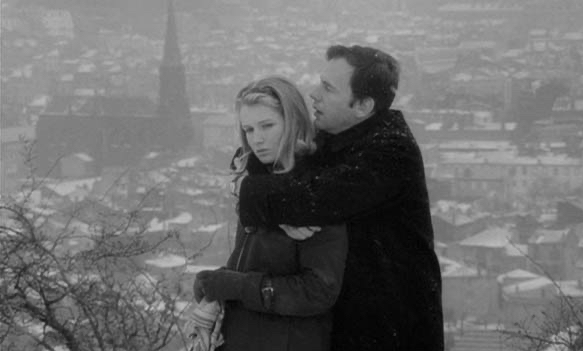
The following night, it’s a very different chemistry between Jean-Louis and Françoise, the blonde girl from the church with whom he is infatuated with at the beginning of the movie. Although they do not share any deep or meaningful conversations, Jean-Louis is convinced that she is the right girl for him because their shared beliefs gives them a higher probability of staying together in a successful marriage. Once they both clear the cloud of doubt that’s hanging over their union, they get married and live happily ever after.
Cast and Crew:
Typical to many movies of this genre, ‘My Night At Maud’s’ was shot on a low budget. The action that unfolds over the titular night at Maud’s apartment takes place over 40 minutes (almost half of the movie) in a single setting. The camerawork by Néstor Almendros is unconventional. Instead of making use of multiple camera angles, we often observe the action through only one camera which stays focussed on a single character for an extended duration. Even though a person who’s speaking may be out of the frame, it allows us to study the expressions of the on-screen character in much more detail. This gives the audience the perception of being a part of the action.
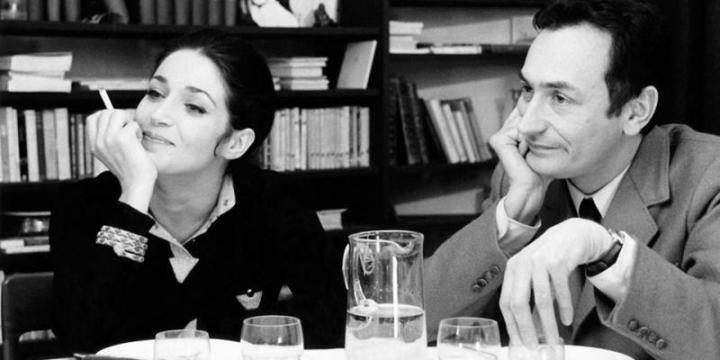
The beautiful Françoise Fabian is exceptional as Maud. She is completely at ease and rises to the challenge of the role. One particular scene of note is when she narrates her life’s story to Jean-Louis. The camera stays on her while she goes through a range of emotions – assertive, charming, mischievous, flirtatious, sad and pensive – over a nearly four minute shot. Western audience may be familiar with Jean-Louis Trintignant, who plays Jean-Louis. He was seen recently in Amour (2012) and previously in Three Colors : Red ( 1994). He is convincing in his portrayal of a self-aware person who sticks to his conviction.
Interesting to note that the director Eric Rohmer was a conservative and a devout Catholic. He was tolerant of other viewpoints and expected other contemporary movie-makers and audiences to be tolerant of his views as well. I noted earlier that all the movies of his ‘Six Moral Tales’ series focus on a single theme. He explains the reason in one of his interviews as rather than finding out six different things that may appeal to the audience, he would rather show them the same viewpoint six times hoping that the audience will come around. He was nominated for ‘Best Original Screenplay’ and ‘Best Foreign Language Film’ Academy Awards.
Final Thoughts:

An intellectual romantic drama from one of French New Wave cinema’s finest directors, this is a must-see movie.
 Lights Camera Action
Leave a comment