
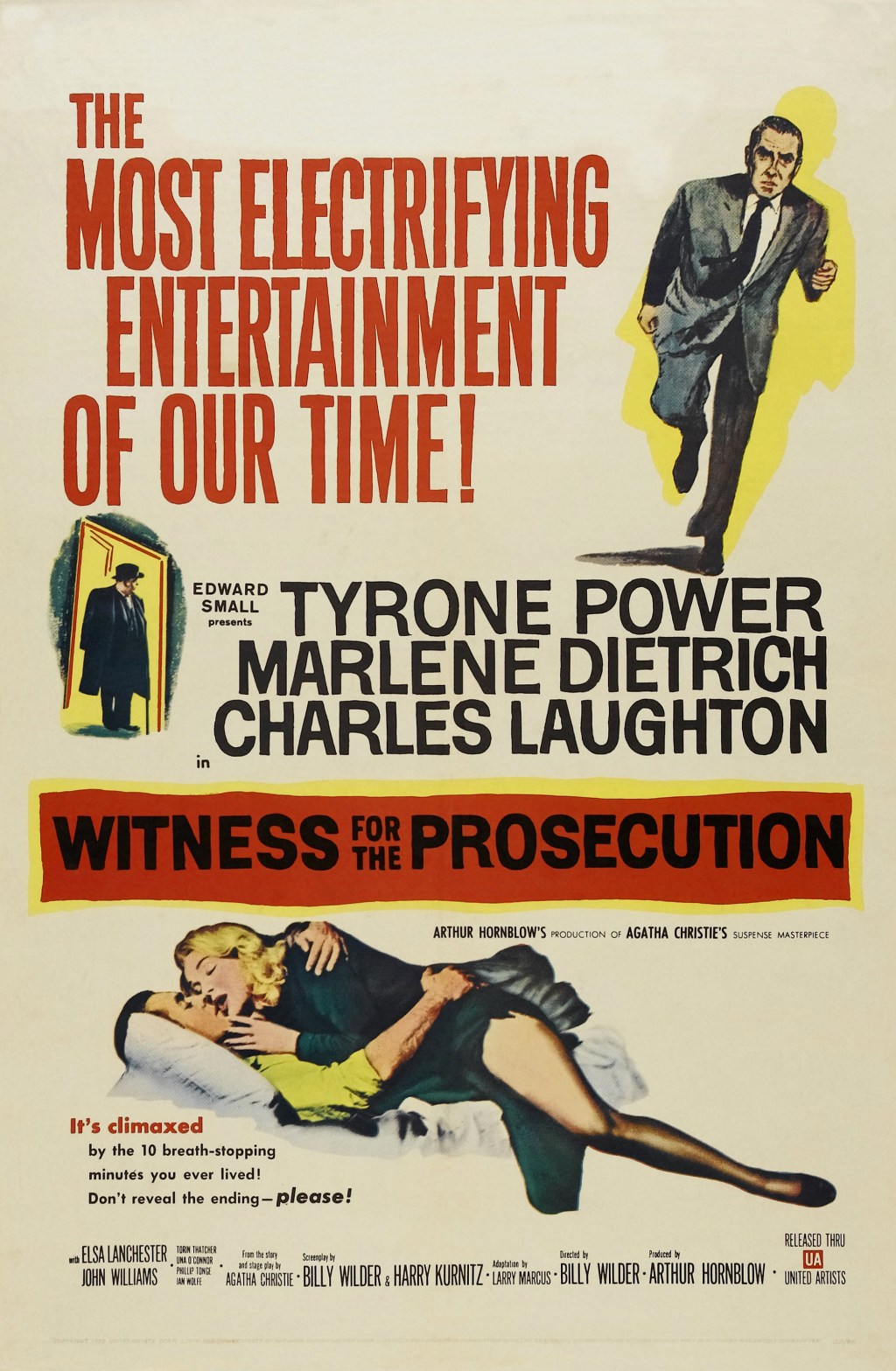
What happens when the queen of mystery meets one of the most versatile directors of classic Hollywood? The result is an engrossing courtroom drama featuring witty dialogues with a touch of humor, a shocking testimony and the quintessential twist at the end.
Agatha Christie is well-known to readers all over the world for her detective stories, often featuring Hercule Poirot or Miss Marple. In addition to writing short stories and novels, she was also a playwright and is credited with writing famous plays like ‘And then there were none’ and the longest running play in history – ‘The mousetrap’. ‘Witness for the prosecution’, which features a murder trial pitting a husband against his wife, was another one of her famous Broadway plays that won her the ‘Edgar award’ in 1955.
Billy Wilder, who’s career spanned five decades, was known for directing several acclaimed movies. His early credits include the noir classics Double Indemnity (1944) and Sunset Boulevard (1950). He followed up these serious movies with Stalag 17 (1953), Sabrina (1954), Some Like It Hot (1959) and The Apartment (1960) – varied movies with an undercurrent of humor as their common thread. ‘Witness For The Prosecution’ follows in the vein of Mr. Wilder’s latter movies where he expertly adapts Miss Christie’s famous play to the big screen while seamlessly blending in his characteristic subtle humor in the process.
Comments:
Agatha Christie adapted her own short story ‘Traitor’s hands’ into a play ‘Witness For The Prosecution’ which premiered in both London (1953) and on Broadway (1954). The play was set as a tight courtroom drama and was an immediate success. While adapting the story on to the big screen, Billy Wilder made a few notable changes. Firstly, he added all the initial scenes outside of the courtroom to provide more context to the murder case that would follow. He thought it would be a good idea to establish his characters thus drawing the audience in and have them feel the desired sympathy for the accused. Secondly, he also shifted the focus from the accused, Leonard Vole, to the barrister who’s defending him, Sir Wilfrid Robarts. This works because it puts the audience in a frame of reference of a more neutral observer. Finally, he also added a few characters, most notably that of Miss Plimsoll who’s a private caretaker for Mr. Robarts. Their ongoing squabble due to her overbearing concern for Sir Wilfrid’s health provides subtle comic relief.
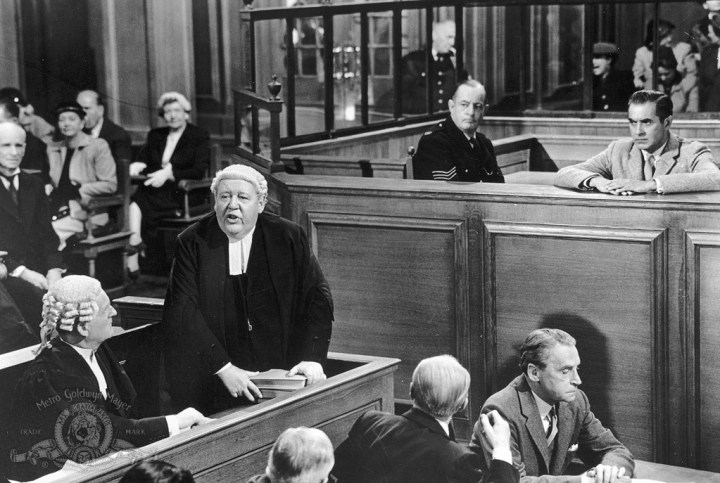
The bulk of the movie takes place in the courtroom. Leonard Vole, a drifter and an inventor of household things, is accused of murdering a wealthy, childless widow. He initially claims to be innocent, but when it’s revealed that just before dying, the widow made him the main beneficiary of her will, he suddenly finds himself with not only a supposed motive but also in need of a good lawyer to get him out of this fix. Sir Wilfrid thinks he’s innocent and is convinced of it after meeting his surprisingly cold wife Christine. The trial features testimonies from the inspector working on this case who presents the circumstantial evidence, the household maid who claims to be a witness and rather surprisingly, Christine, who takes the stand to testify against her husband.

This last witness for the prosecution throws a wrench into Sir Wilfrid’s calculations. Mr. Wilder indicates it as such by the clever use of the medicinal pills that Sir Wilfrid is fiddling around with on his desk. Sir Wilfrid initially arranges them in an orderly manner during the expected testimonies but disrupts them during this unexpected appearance by Christine as a witness for the prosecution. This damning testimony is a big blow to the defense team and things are looking bleak. But with no other solution in sight, Sir Wilfrid finds help from an unexpected source and that pretty much seals the case. That’s all there is to say without revealing the ending of this gripping movie.
Even though the movie features a tense murder trial, it does not take itself seriously. The cynicism of an ailing Sir Robarts, who’s just recovering from a heart attack, forms the main source of humor in the movie. The witty banter between him and his caretaker Miss Plimsoll is subtle and does not feel forced. A particularly funny incident is at the beginning of the movie when the accused Mr. Vole suddenly finds himself surrounded by three lawyers – Mr. Mayhew, a solicitor who he is referred to; Sir Robarts, the senior barrister who’s actually registered to plead the case in court and his junior counsel Mr. Borgan-Moore, who inherits the case as the doctor has advised Sir Robarts against it due to his poor health. When Mr. Vole says that he may be unable to pay the fees of so many lawyers, Sir Robarts assures him to not worry as they will find a fourth lawyer to sue him in that case. In a similar vein, his interactions with the prosecutor, the judge as well as with the witnesses are humorous as well. It is not an easy thing to keep the mood light throughout the movie and at the same time, not distract the viewer from the case at hand. Mr. Wilder pulls off this tightrope walk and strikes the perfect balance.
Cast and Crew:
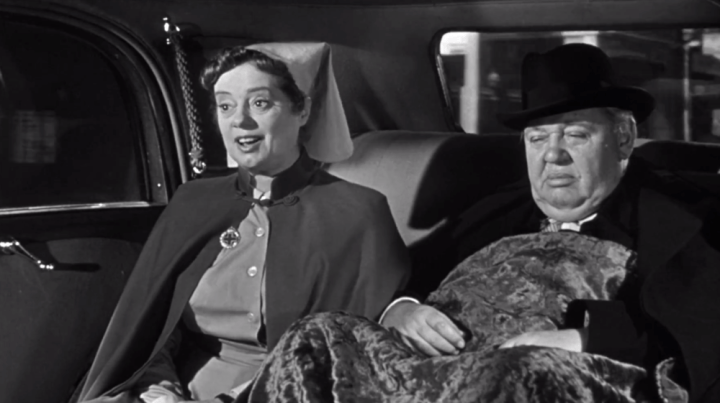
Charles Laughton plays the cynical and ailing barrister Sir Wilfrid Robarts. Through his bored demeanor, dismissive dialogue delivery and sharp wit he brings the pompous and workaholic character of Sir Wilfred to life. He is a person who clearly hates to lose but wants things done on his own terms and that explains his restlessness upon finding the solution of the case tied up a little too neatly for comfort. A recurring theme in the movie is Sir Wilfrid’s feud with his nurse Miss Plimsoll played by his real wife Elsa Lanchester. The on-screen chemistry between Mr. Laughton and Miss Lanchester is simply electrifying.
Tyrone Power plays Leonard Vole, the accused drifter. Mr. Power plays different aspects of his role convincingly – initially he is taking things lightly as he believes himself to be innocent, but is later shocked and surprised to see his own wife appear as a witness for the prosecution. Even when things are advancing in an unfavorable direction, he displays unflinching love for his wife. Sadly, Witness For The Prosecution was Mr. Power’s last completed film as he died of a heart attack while shooting for his next role as Solomon in the movie Solomon and Sheba (1959) – a role that went to Yul Brynner.

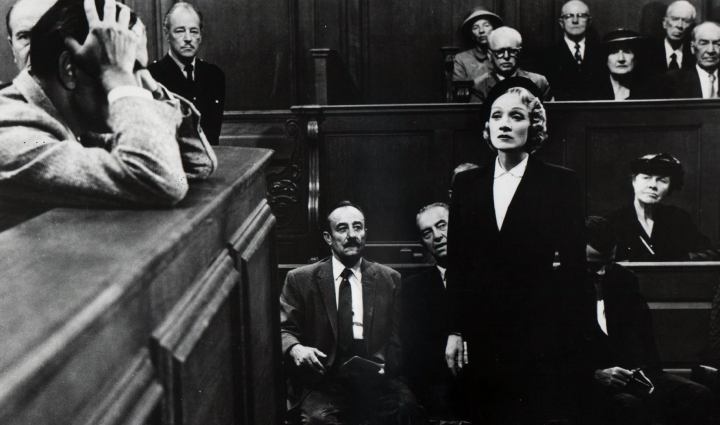
His wife Christine’s role is played by Marlene Dietrich. Miss Dietrich was a German-born, American actress who was famous for her stylish and androgynous appearances. She frequently appeared in trousers and hats in drag style as well as featured prominently in cabaret roles. She had carefully cultivated her persona as a fashion symbol. Mr. Wilder simply could not resist the temptation of showing off her famous legs in a bar scene specifically inserted in the movie for this purpose. In another scene, when her character Christine meets Sir Wilfrid for the first time, he thinks of her as a cold and self-assured woman. In fact, Miss Dietrich’s stone cold expressions were achieved by her own unique style of getting a facelift done by pulling her hair and tightly taping it further back onto her head. Albeit in a short role, Miss Dietrich gives a memorable performance. Her anguished ‘Damn You! Damn You!‘ scream in the courtroom will ring in the audience’s ears long past the end of the movie.

‘Witness For The Prosecution’ is mistakenly considered by many as a Hitchcock movie. Billy Wilder, an acclaimed director in his own right, can definitely take this compliment in its stride. True to Hitchcock style, Mr. Wilder keeps us guessing until the very end about the innocence of the accused. He does a fabulous job of adapting the script to the big screen, of character development, and getting the best out of his actors. It is said that Agatha Christie thought this was one of the better movie adaptations of her stories. At the end of the movie, there’s an announcement requesting secrecy from the audience in regards to the movie’s plot. This oath of secrecy was also enforced by the producers and director for all actors and visitors on the sets. In an interesting twist, many believe this may have cost Miss Dietrich an Academy award nomination.
Final Thoughts:
‘Witness For The Prosecution’ is one of the finest adaptation of Agatha Christie’s works and features at #6 on AFI’s ’10 Top 10′ list in Courtroom Drama section.
 Lights Camera Action
Leave a comment