
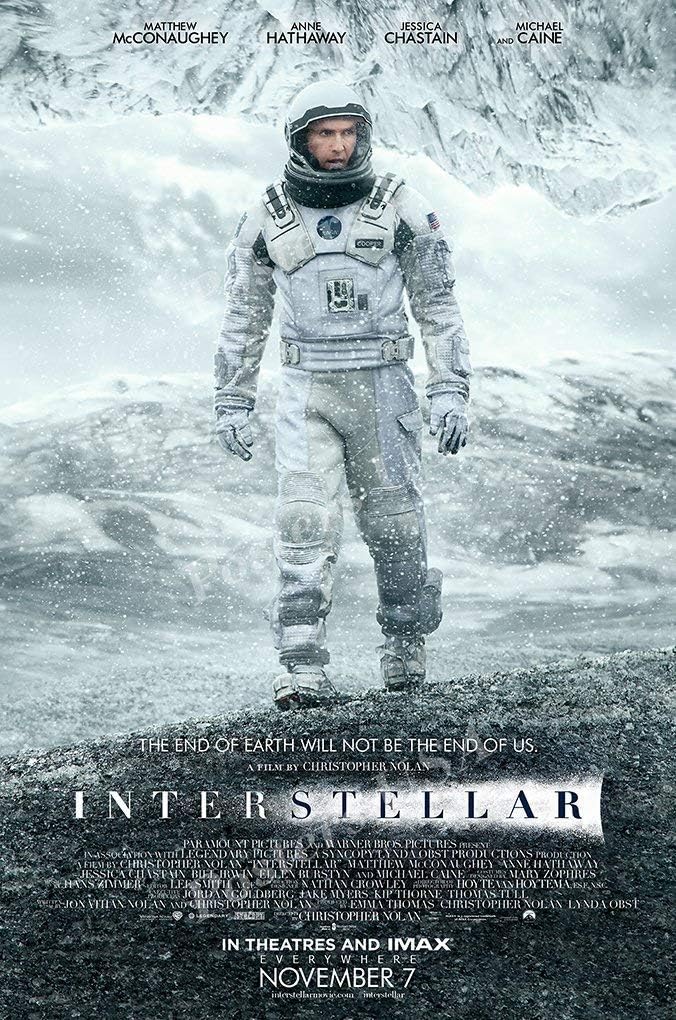
Climate change has been one of the most commonly discussed topics in the last decade or so. Despite the severe warnings of the dangers this phenomenon possesses to the very existence of humanity, the general public doesn’t seem to be very worried about it. The reason could be partly attributed to its overuse in the media, but in my opinion, it’s largely due to the fact that climate change occurs rather slowly for us to take notice. Unlike a hurricane or a snowstorm, it does not manifest itself in a short amount of time. Rather, its impact is being felt over a few decades, about the same as the length of a human lifespan. And this makes the lurking threat posed by climate change harder to grasp. In ‘Interstellar’, director Christopher Nolan gives a glimpse of what may lie in store for us if we do not heed the present day warnings. He portrays a catastrophic future, one where humanity has retrogressed to its farming roots and has been reduced to simply being in the custodian’s role doing crisis management. But he also provides hope that the explorer gene in our species will be able to carve out a future for itself against all odds. Dylan Thomas’ oft repeated poem in the film is indicative of that undying spirit.
Do not go gentle into that good night, Old age should burn and rave at close of day; Rage, rage against the dying of the light.
– Dylan Thomas
‘Interstellar’ is not just any science fiction movie which takes our everyday battles between good over evil and sticks them into the intergalactic theater some time in distant future. Rather, it deals with the practical effects of climate change and the threat to the survival of our species – like what crops can we continue to produce, how will the energy crisis play out and how will we have to adapt to these inevitable changes. It also tackles the core question that we will have to answer someday – Do we adapt and survive on this planet or eventually leave the only home that we have ever known and venture out into the unknown. Cooper, the protagonist of the movie, hints at the answer by saying “Mankind was born on Earth. It was never meant to die here.” This journey of ours to find a potential future home forms the crux of the movie – a journey that covers approximately 10 billion light years or …hold for it…. 58,786,253,732,000,000,000,000 miles.
Now before you start questioning that number, let me say it again – ‘Interstellar’ is not just any science fiction movie. Here comes the science part and there’s a lot of it. Allow me to geek out for a moment and introduce a few key concepts from physics like black holes, wormholes, the fabric of spacetime and time dilation (which is a core phenomenon of Einstein’s theory of relativity) that you need to know to better understand the movie. The movie does a good job of explaining them in a simple enough way for the audience to make sense of what’s happening. The science and the math behind the movie is all real on a theoretical level1. So within the realms of Einstein’s general relativity, it is possible to travel through a wormhole (which is nothing but a connection – or a “portal” – between two distant points in spacetime) to a different part of our universe that would normally be way out of our reach. This explains the insanely large distance mentioned in the previous paragraph and just goes to show how bizarre our universe is – beyond anything that we humans can perceive. Simply put, ‘Interstellar’ is perhaps the most ambitious project undertaken by a director – one where humanity is seeking to conquer the ultimate frontier of infinitely large outer space.
Comments:
The movie opens with clips of some old people talking about a calamity from their past but it seems like they are describing a time from the not-so-distant future where climate change has severely impacted human life. To add to the confusion, when they say that everyone was a farmer back then, it is interspersed with shots of Cooper (Matthew McConaughey) piloting a spaceship. This unique editing style of interspersing multiple scenes playing out across different times and places is often used in the movie. On first look, the time and place being described looks like the Dust Bowl of 1930s in Oklahoma and Kansas. It is reminiscent of how the blight and sand storms ravaged through the Central Plains destroying huge swaths of crops and affecting farming communities. The large IMAX film format and Hans Zimmer‘s haunting soundtrack beautifully sets this up.
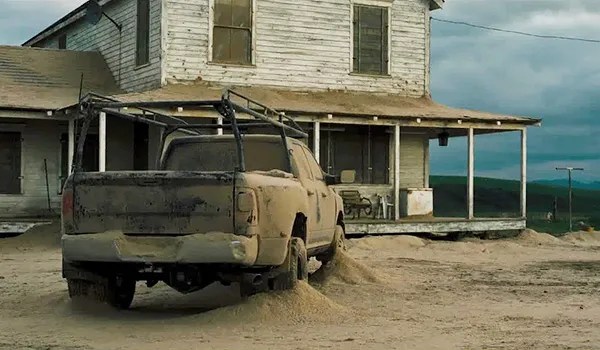
We eventually learn that we are looking at some time in near future where humanity is on the brink of exhausting earth’s resources and hence we are in the process of shrinking our footprint. NASA has gone into hiding as there is not enough public support to fund such “frivolous” programs. However, they are secretly deploying missions to distant parts of the universe in search of habitable planets. These missions are our best – and possibly only – hope for survival. In search of potential home(s), a crew of four astronauts and two robots embarks on an epic adventure – one that will take them through a wormhole possibly never to return to their loved ones and to the planet they call home.
Even with its focus on complex concepts in Physics and the crew’s interstellar adventure, the movie is heavy on drama. Cooper and his scientific minded daughter Murph share a special bond in the movie and his imminent departure from earth is an emotionally fraught moment for both of them. As Cooper explains to Murph the concept of ‘time dilation’ or how time will slow down significantly for him now that he’ll be traveling at comparatively very high speeds, she realizes that she may never see him again within her lifetime. Murph is so disturbed by this that she refuses to bid farewell to her departing father. It is a gut wrenching scene as the interspersed shots of Cooper’s truck departing their farm and a space ship departing earth play out on screen and Murph’s cries are drowned out by Hans Zimmer’s crescendo.

There are a couple of similar poignant moments later on in the movie as well. One is when Cooper, after getting subjected to the time dilation on Miller’s planet, sees glimpses of life on earth that has passed him by. And without giving away any spoilers from the second half of the movie, there’s another scene where a character wakes up from deep sleep to see other humans after a gap of thirty years and breaks down sobbing heavily. Both these scenes depict extraordinary moments which would never happen ordinarily in our lives but just go on to show that when it comes to space travel, fact is indeed stranger than fiction.
The Science of Interstellar:
There are many details in the movie that may be easy to miss upon first viewing. I was impressed by the fact that they have tried to answer quite a few questions that may arise in a curious mind. For example, I was wondering how the debris of a space ship can float so close together in an ocean after over 10 years. But my doubt was cleared when they explained that although it may have been well over a decade on earth, the space ship would’ve just landed about an hour ago on a planet that lies in the gravitational well of a black hole. As a side note, there’s a rhythmic ticking in the background through the entirety of the crew’s stay on this planet at an interval of about 1.25 seconds. This is no coincidence and was planned that way to coincide with the passing of each day back on earth.
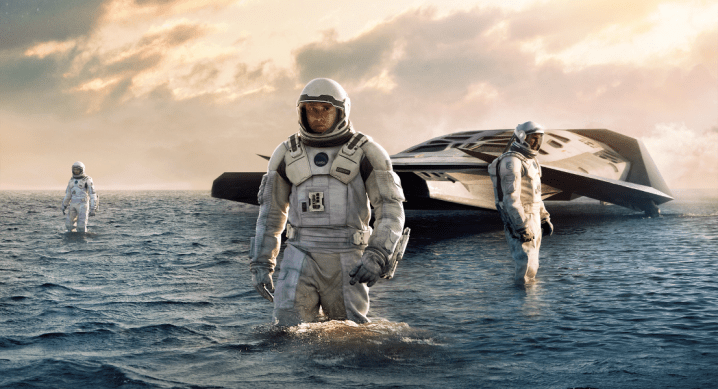
The close attention to detail is evident in relatively minor things. Like the way Cooper, who’s an experienced pilot, tilts his body in the direction opposite to that of the spinning motion of the lander while docking with the space ship. This helps him to avoid a blackout while his colleague Brand, who’s a scientist, may not be experienced enough and does exactly the opposite, before passing out. There’s also the small matter of gravity to deal with, as a lengthy trip in space would be much more comfortable for the crew if they are not floating around in space under zero ‘g’. So their space ship Endurance is spinning in order to simulate the artificial gravity needed to keep the crew “grounded” – very similar to the one in another sci-fi classic ‘2001: A Space Odyssey (1968)‘.
*#*#* Mild Spoilers Ahead *#*#* (Skip)
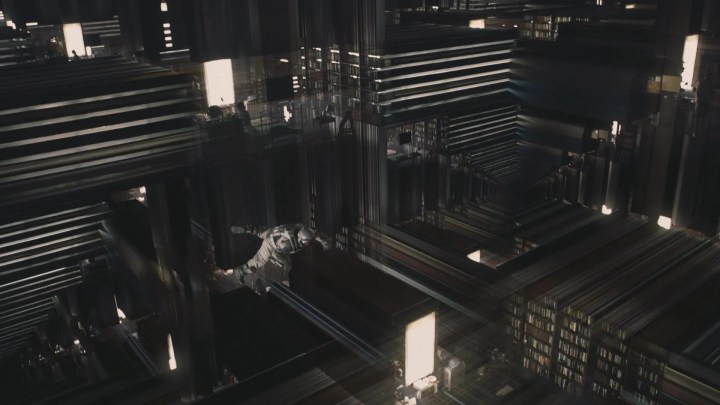
However, the most controversial aspect of the movie is undoubtedly the ‘tesseract’. It is the grid like structure in which Cooper seems to be suspended towards the end (or is it the start?) of the movie. But how does Cooper even get there? And what purpose does it serve exactly?
Let’s start with the how part first. It is a well established fact that it is impossible to peer beyond the event horizon of a black hole and live to tell the tale due to the runaway gravitational force that would take hold of the observer. But since this critical information from within the black hole is needed to solve Prof. Brand’s gravity equation, Cooper and TARS (one of the two accompanying robots) do the unthinkable and intentionally fall inside the black hole to gather the data. Since the regular laws of physics break down beyond the event horizon, any theoretical possibility is fair game for a movie director. This takes us to the tesseract – which simply put, is a four (spatial) dimensional equivalent of a cube. This shape is difficult to perceive for us humans who are bounded by just three spatial dimensions or ‘spacetime’, if you consider time as the fourth dimension. However, unlike how we have freedom to hop around the three spatial dimensions (by moving front and back, left and right and jumping up and down), we can move in only one direction on the time axis, and that is forward.
But why do we even need the tesseract? By entering it, Cooper gets access to a higher dimension (fourth spatial dimension outside of spacetime) and thus becomes a higher order being. By virtue of this, he is not bounded by the unidirectional flow of the time axis anymore and he can access the timeline as freely as humans can access the other three spatial dimensions normally. This gives him access to all timestamps inside Murph’s room. He can now pass on the information that he has collected, in the form of gravitational waves which are unaffected by anything and can transcend dimensions2.
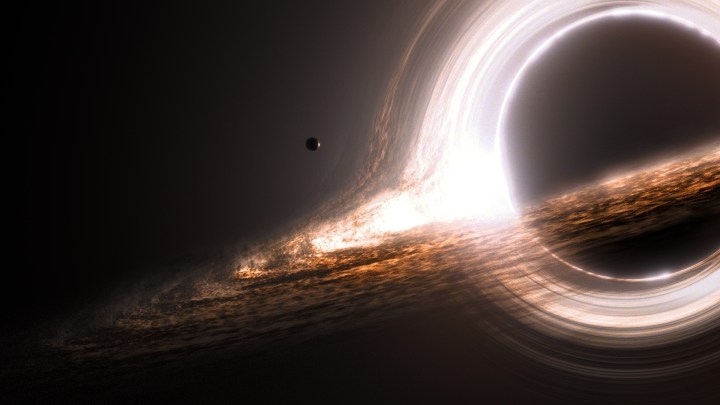
Of course, the movie has some wildly impossible parts that are even theoretically impractical. A couple of examples come to mind – the crew travels to a wormhole that has opened up near Saturn for over two years before zipping through it to another part of the galaxy. In reality however, wormholes are not stable and they would require tremendous amount of negative energy3 to stay open. So even if we do detect a wormhole, it will not remain open beyond a fleeting moment, forget two years. Similarly, it would be virtually impossible to sustain life on any planet which is in such a close proximity to a supermassive black hole like Gargantua. It would be an energy (including light) sink leaving little to no energy for life to thrive on such a planet. But the creators have gotten most of the other parts right to stunning effect and such a creative license enhances the motif beautifully here in this movie. So they deserve a pass over a few grossly exaggerated ideas.
*#*#* End Spoilers *#*#*
Cast and Crew:
Christopher Nolan has made some great movies – the Dark Knight trilogy, Inception (2010) to name a few. But I think that Interstellar would end up being the crowning achievement of his career and last the test of time. From its idea to realization, the movie is truly gargantuan (pun intended) in scope. Many people are familiar with relativistic physics, but to see its effects actually play out on real humans is still surreal. And through all this he has managed to keep the soul of the movie intact and not just let it devolve into an intergalactic adventure. The problems highlighted in the movie are real, and the emotions even more so. Murph’s sense of abandonment and the resulting grief is palpable. So is Cooper’s and Dr. Brand’s sense of loss of loved ones that they have left behind. Mr. Nolan also speculates on how long stretches of isolation would affect the future space travelers. Humans are a social species and no matter how ready and trained one might be, loneliness is a powerful tool in evoking a negative response in humans. Kudos to him for taking a very difficult topic and making a popular sci-fi movie out of it.
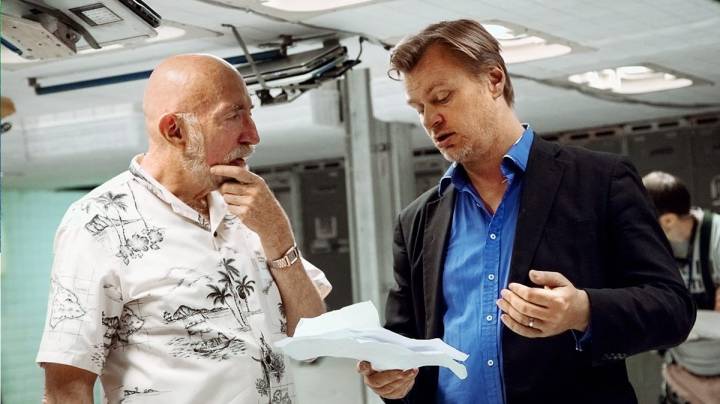
Nobel laureate Kip Thorne, who is one of the world’s leading theoretical physicists, acted as a consultant on this film. His extensive work on relativistic physics, black holes and gravitational waves was instrumental in making this movie. In fact, the visualization of the accretion disc around the black hole and the effects of gravitational lensing around it was a direct result of his calculations. This was the first time a wormhole or a black hole has been depicted visually based on Einstein’s theory of relativity. Easter egg alert: As a nod to his contributions, the decommissioned robot on Mann’s planet was named Kip.
Hans Zimmer’s music is the life and soul of the movie. From the thrilling chase through a cornfield to the tense docking of a space station it consistently hits all the right notes. Interestingly, when Mr. Nolan approached Mr. Zimmer with the offer, he never mentioned the scope, nor the story of his production. The meeting happened in a church and organ music formed a core part in the session. It couldn’t have worked out better as the majestic organ music suits the scale of the movie perfectly and takes the soundtrack to another level..
Matthew Macconaughey is brilliant in his role of an ex-NASA pilot turned farmer. 2012 – 2014 was a purple patch in his career with various challenging roles in movies like Mud (2012), Dallas Buyers Club (2013) and HBO’s True Detective (2014). Here too, he displays a wide range of emotion – from being a doting father to Murph to someone who’s disillusioned with the current state of affairs and itching for an adventure. There are situations in this movie related to time dilation that no person can ever experience and Mr. Macconaughey does an exceptional job during these scenes mainly through his expressions. Watching him go through the emotional gamut while seeing his family after a “long” gap brings a tear to the eye even after repeated viewings.
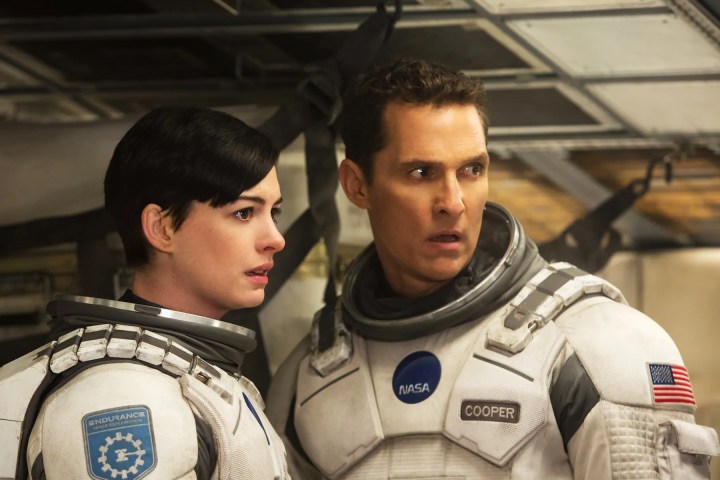
Anne Hathaway is underrated in her role as Dr. Brand. She is the daughter of Prof. Brand (played by Michael Caine) who is the father figure of the new, underground NASA. She is a strong woman who makes the ultimate sacrifice for love, twice, in the interest of science. Her subdued performance in this supporting role is a testament to her talent. As a side note, she maintained short hair for the film so that they won’t have to worry about showing its movement in zero gravity scenes.
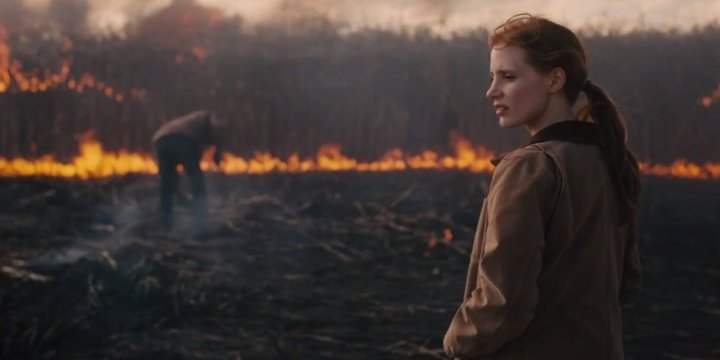
Jessica Chastain plays the older version of Murph. And yes, for those of you who still haven’t gotten your head wrapped around the effects of time dilation, you read that right! She plays the character of Matthew Macconaughey’s daughter. Her younger version is played by the talented Mackenzie Foy. While the younger Murph is the quintessential daddy’s girl who seeks her father’s approval and thinks the world of him, the older Murph is a wiser and hardened woman who feels betrayed and disillusioned because of her father’s apparent abandonment. Both actors play their part well. Side note: during my most recent viewing, I realized that the role of younger version of Tom (Murph’s brother) is played by a young Timothée Chalamet whom I had never noticed before.
Final Thoughts:
Interstellar is a cinematic landmark and a towering achievement in storytelling. It is one of the best sci-fi movie ever made and also one of my top five movie recommendations. Mr. Nolan has managed to make science cool again.
1 We are nowhere close to achieving space travel over these vast distances. Our current understanding of physics doesn’t allow us to travel even remotely close to the speed of light which is approximately 186,000 miles / second (300,000 kilometers / second). At this insanely high speed, it would still take us about 90,000 – 100,000 years to simply travel across our own galaxy.
2 Interestingly, this same argument is put forth by Dr. Brand (the daughter of Prof. Brand) about going to Edmund’s planet – the subject here being love. It is something that cannot be explained and that transcends dimensions.
3 Read all about the stability of a wormhole here.
 Lights Camera Action
Leave a comment