

There is as much passion amongst fans about the sports they follow as there is about the movies they watch. As someone who follows both, I sit at the intersection of these two fan bases. Although the level of love for your favorite sportsperson or artist may be the same, there are a few differences. A legendary career may last for about 20 years in the sporting world (Tom Brady in American Football, Sachin Tendulkar in Cricket to name a few), whereas it may span a good five or six decades in the movie industry. And while it may be easy to crown Michael Jordan as the G.O.A.T (to borrow a sporting term) in baseketball based on statistical data and common grounds for comparison, it is really hard to single someone out when it comes to movies. But if there would ever be a Mount Rushmore for Directors and Actors, then arguably Martin Scorsese, Robert De Niro and Al Pacino would feature on it. These three legends along with the inimitable Joe Pesci team up in the modern day classic, ‘The Irishman’.
The Irishman is based on the book ‘I heard you paint houses’ by Charles Brandt. The sinister title refers to the job of a hitman who ends up painting the walls with the blood of his targets. It tells the true story of a mob hitman Frank Sheeran (played by Robert De Niro), who started off as a delivery driver but soon under the wings of crime boss Russell Bufalino (Joe Pesci) rose through the ranks and worked as an enforcer / bodyguard for the powerful labor union leader Jimmy Hoffa (Al Pacino). Frank is born in Pennsylvania, but because of his paternal heritage, he is referred to as ‘the Irishman’ within the Sicilian mob circles.

The movie is narrated in a flashback and follows multiple timelines – a style that’s reminiscent of Goodfellas (1990), another of Mr. Scorsese’s mafia classic. However, unlike Goodfellas, which starts with one of the most famous opening lines in movie history (“As far as I can remember, I always wanted to be a gangster“) and throws us right into the action in the middle of a hit job, The Irishman takes a contrasting approach by showing an octogenarian, wheelchair bound Frank Sheeran in an old age home. Frank is detailing his life story from his rise in the Bufalino organized crime family starting in his mid-20s and leading up to a road trip that he and Russell (known as Russ) are taking with their spouses to attend a family wedding in Detroit three decades later. The journey culminates into what proves to be a defining moment in his life. Through flashbacks, Frank recounts the important events and people in his life. We see Russ mentoring and protecting him through some of his early mistakes, his bond with Jimmy Hoffa and the impact his choices have on his personal life including his strained relationship with his daughter Peggy. It must be said that although the story jumps about in time a lot, it is relatively easy to follow.
Comments:
The release of Francis Ford Capolla‘s The Godfather (1972) launched the golden age for mob movies in Hollywood that lasted from the early ’70s to mid ’90s. Along with its well known sequels Godfather II (1974) and Godfather III (1990), movies from other iconic directors such as Sergio Leone‘s Once Upon A Time In America (1984) and Brian De Palma‘s The Untouchables (1987) & Carlito’s Way (1993) also made a mark. But arguably, the most influential name was that of Martin Scorsese. His collaboration with Robert De Niro and Joe Pesci produced some of the best movies of all time. While sticking with the tried and tested formula of epic story telling and a longer runtime that’s common to this genre, Mr. Scorsese distinguished himself with his own brand of fast paced action and crisp dialogues.
During the course of the movie, Frank Sheeran meets several people of senior and junior ranks within the mafia. Mr. Scorsese deploys a unique style of showing their names along with the future date and nature of their death, often brutal. No matter how well they may have been doing at the time, it is a ruthless business after all and if someone is becoming an obstruction to the mob, he has to go. Behind all the glamor, this is the jarring truth about the life in mafia. Given that he started off as an outsider (an Irishman in a Sicilian crime syndicate), the main reason Frank survives this ruthless game is because he treats his job as an army lieutenant and does whatever he is told without asking questions of his superiors. Or as he says “you follow orders, you get rewarded”.

While Frank is climbing the ladder and earning the trust of his fellow mobsters, it’s a very different story for him on the personal front. His daughter Peggy is aware of the kind of business Russ Bufalino is running and she thinks that her father is turning into a monster by working alongside him. She’s also sees her father brutally beat up a store owner who harasses her instead of handling the matter in a civil manner. So although Frank and even Russ have always shown affection and care towards their family, Peggy is distrustful of them both. There is a good scene in a bowling alley where Russ and Frank are spending time with their families that shows this dynamic. On the other hand, as Jimmy Hoffa gets closer to Frank’s family, Peggy grows fond of him right from the onset. This is because she knows Hoffa as this charismatic leader and a true friend of the working class community and has not seen his bad side. This eventually leads to her estrangement from her father, something that he finds hard to accept.
One of the most underrated aspect of this movie is its climax. It is anything but thrilling. In fact over the course of the final forty minutes or so barely anything of note happens. But it is an intentional choice and reflects our life where generally speaking, almost all the interesting things happen while we are younger. Most of the climax unfolds in Frank’s old-age home with all the significant events and people in his life in the rear-view mirror. Frank is seen attempting to mend the relationship with his daughter Peggy but he learns that she just couldn’t come to him for the fear of the terrible things that he may do. We see him planning for his death when he talks about choosing a crypt over cremation as it will remain in its place long after he’s gone. By doing this, death feels less final to him. This is an amazing insight into the mind of an aging person who has no further significant goals to achieve and is just biding his time.
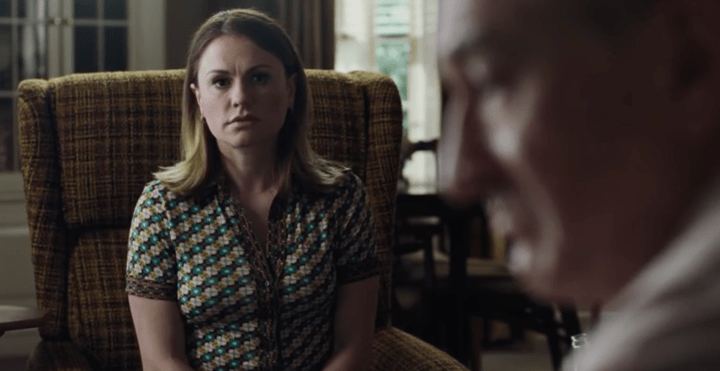
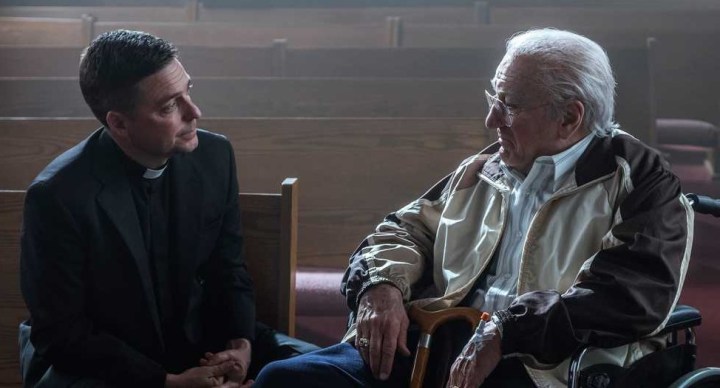
There’s a mildly amusing moment when a couple of journalists are trying to probe into Frank’s past to find answers to some unsolved events. Never one to rat out his associates, he refuses to answer their questions until his lawyer’s present. When told that his lawyer is dead, he impulsively asks “Who did it?”. This is at once a funny and dark moment where the possibility of his lawyer dying due to natural causes doesn’t even occur to him. With everyone around him gone – Russell, Salerno, Angelo, Tony Pro, Sally Bugs – all dead due to various reasons, Frank Sheeran is the only survivor from the days past. He talks to a priest looking for an absolution, but does not feel any remorse in his heart, because he had never known any of the families except Russell’s. He talks to the young nurse and tells her about his family and Jimmy Hoffa. But seeing her blank expression, he realizes that she has never heard of Jimmy – whose fame rivaled that of the President of the United States back in the day. It’s a gentle reminder of how time and tide waits for no one and the prominent figures of yesteryears are nothing but a blip in the passage of time.
Simply put, this ‘anti-climax’ is a prime example of masterful direction that takes the viewers well beyond the story’s logical conclusion and dares to probe the uncomfortable topics of one’s golden years. This extended finale perfectly symbolizes the old age for all irrespective of whether you were a prince or a pauper during your lifetime. With the inevitability of death looming large, the only things that you are sure to possess are your thoughts and memories and the time that’s allocated to you.
Cast and Crew:
It is indeed surprising to note that although Al Pacino and Martin Scorsese both have had long and successful careers, this is just their first time working together. Mr. Pacino plays the role of union leader Jimmy Hoffa and effectively brings out his egotistical, power hungry and alpha personality. Being the leader of one of the most powerful worker’s unions meant that he was not used to taking no for an answer. This headstrong and tempestuous attitude is wonderfully portrayed by Mr. Pacino in a couple of scenes with Tony Pro, especially the one in Florida where Tony arrives late for their meeting. He also doesn’t back down when Russell warns him through Frank as a last resort about going against the mob and advises him to tone down the rhetoric. From this eccentric and self-assured nature to the rapidly shifting expressions of shock, fear and anger in a particular courtroom scene where someone tries to stab him, Mr. Pacino’s acting range is on full display here.

Joe Pesci plays the crime boss Russell Bufalino with an uncharacteristic restraint. When you think of Joe Pesci, you are thinking of Tommy DeVito in Goodfellas (You think that’s funny?). But Mr. Pesci’s Russ couldn’t be any more different than Tommy. Tommy is an eccentric, over-the-top maniac who’s ready to explode at the slightest provocation whereas Russ is wise, calm and deliberate. He is aware of the weight on his shoulder of being a patriarch of a crime family but at the same time is not hesitant to downplay his own importance to soothe other bigger egos. In fact, this role is so different to what Mr. Pesci has played in the past, he himself wanted to play another character (that of Tony Pro, whose flashy and arrogant nature is more in tune with what we are used to seeing from him). But we should be glad that Mr. Scorsese convinced him to come out of retirement and play the part of Russ which allows us to see this side of Mr. Pesci. Just look at the scene in the restaurant where he just casually brushes off the insults hurled at him by Joe Gallo. But in a crime syndicate, you don’t mess with a boss. Voices aren’t raised, in fact no words are exchanged. But just a look between Russ and Frank is enough for us to realize what’s coming next for Joe.

The titular character of the Irishman is played by the Robert De Niro who’s the heart and soul of the movie. As a narrator of this story, we see all the events through his eyes – from his humble beginnings in his 20s as a truck driver (strange to hear a 78 year old Mr. De Niro being called a good kid) through his rise in the mob. Mr. Scorsese has used innovative CGI techniques to make all his actors look younger to cover the decades long span of the movie. It is nowhere close to perfection but even if it was, CGI can only take care of the appearances. Mr. De Niro puts on a masterclass in acting through nuanced differences in his body language, energy and dialogue delivery to convincingly play Frank Sheeran through different phases of life. Just observe him apologizing to Russ and Angelo at the start of the movie due to the naïve mistake in his youthful exuberance and compare that with the old Frank Sheeran in his wheelchair who’s mumbling and garbling up the ends of his sentences. Frank Sheeran’s character takes a back seat to almost all the characters through the first three quarters of the movie but when it comes to the ‘anti-climax’, Mr. De Niro, the actor, simply owns it. He portrays the air of melancholy around an aging but remorseless Frank to absolute perfection.
One of the strengths of this movie is the screenplay by Steven Zaillian. When one thinks of a mob film, the first line that comes to mind is ‘I am gonna make him an offer he can’t refuse.’ It is famous for its simplicity as much as for its implied meaning. Mr. Zaillian’s script is powerful and has many such memorable quotes which are an all too common feature of crime movies. There are subtle warnings like “Nobody’s gonna want to shop here anymore” and “It’s what it is”. Then there is the time when Jimmy is complaining to Frank about someone and Frank asks “What do you want me to do?” To which Jimmy replies “No, not that”. And finally there’s this quote from Frank “Three people can keep a secret only when two of them are dead”. Even beyond these, there are long elaborate scenes like the aforementioned one with Jimmy and Tony Pro in Florida and the ones between Jimmy and Frank which lend a certain depth to the characters and contribute to their development. It is a credit to the movie’s tight screenplay that its three and half hour running time does not feel long. Mr. Zaillian’s work earned him an Academy Award nomination for Best Adapted Screenplay.
And finally, what can be said of director Martin Scorsese that hasn’t been said already. With classics such as Mean Streets (1973), Taxi Driver (1976), Raging Bull (1980), Casino (1995), Gangs of New York (2002) and The Aviator (2004), he’s had an remarkable career spanning over five decades. And as he said in one of his recent interview with Vanity Fair, he’s not done yet. His latest movie Killers Of The Flower Moon (2023) premiered last year to critical acclaim and is surely to be in contention at the 2024 Academy Awards ceremony. An auteur in his own right, Mr. Scorsese’s imprint is all over the movie. The intermittent narrative style, the flashbacks jumping in multiple timelines, the engrossing lengthy scenes featuring banal but gripping dialogue – all the usual Scorsese trademarks appear in the film. But this time he has outdone himself by allowing his own state of mind to permeate into the film’s long drawn (and masterful) finale. As he says in that same interview, he has a lot of stories to tell, but he doesn’t have the time as he’s old. This realization of life’s finiteness has crept into Frank’s thoughts when he’s in the old-age home. In the final scene, he talks to the nurse and the priest who occasionally come to check on him and reminds them that he’ll be there, he’s not going anywhere. As the camera pans out of his room, we leave him in his wheelchair alone reflecting on his life. This scene shows a director who’s in complete command of his medium. And by the way on a completely different note, I couldn’t agree more with his views on Marvel blockbusters. Mr. Scorsese is a true connoisseur of cinema and a national treasure.
Netflix, having produced this movie, has also released a nice accompanying informal chat featuring Mr. Scorsese along with the three lead actors on its platform. Addressing the long runtime of the movie, he says that he made the movie for the love of it and not for the money or masses and that is why length doesn’t matter. But long does not mean that it is slow. In fact, it is so well paced that to quote Frank “You don’t know how fast time goes by until you get there.”
Final Thoughts:

With its illustrious ensemble cast and director, The Irishman is one of the finest movies of the past two decades. Overcome your fear of long movies and cherish this masterpiece.
 Lights Camera Action
Leave a comment