

*This review contains spoilers which may be skipped*
Often times, filmmakers excel at one type of films and rarely venture outside of their forte. They tend to stick to a tried and tested formula which has brought them success and choose to explore nuances within the genre itself. Some of the famous examples include Alfred Hitchcock (suspense), Sergio Leone (spaghetti western) and Eric Rohmer‘s ‘Six Moral Tales collection‘ (six movies that focus on temptation). Conversely there are others, like the talented and versatile Taiwanese-born director Ang Lee, who excel in variety. From late 18th century England in Sense and Sensibility (1995) to the 1970s suburban Connecticut of The Ice Storm (1997) and from the cowboys of Wyoming in Brokeback Mountain (2005) to the treacherous ocean journey of an Indian family in Life of Pi (2012), Mr. Lee’s films have taken us on quite a journey through starkly different settings and eras. But arguably his best film to date, and one that made him a household name, is the Wuxia style martial arts epic Crouching Tiger, Hidden Dragon (2000). The film is set in North-western China during the Qing dynasty’s rule.
Crouching Tiger, Hidden Dragon is based on a novel of the same name. The book is part of the Crane-Iron pentalogy and belongs to the Wuxia fiction genre, which is characterized by heroes who follow a certain righteous code of conduct and lead a mostly ascetic life. The movie talks about a warrior clan based in the Wudang mountains and tackles various themes like sense of duty, love, freedom, even sexism and ultimately sacrifice. It is shot beautifully and has some of the most exhilarating martial arts action sequences ever filmed. Granted, people flying around while fighting may seem silly to many viewers. On the contrary, not only is it exciting to watch but in the fantasy world of Wudan warriors, it even seems natural. Thanks to the popularity of this film, many Wuxia films like Hero (2002) and House Of Flying Daggers (2004) have later made their way to Hollywood.
Comments:
The title of the movie refers to the heroes who have to hide amongst the common people and abide by society’s rules. Sticking to simple, monk like ways, these warriors curtail their natural instincts for most part and only during crisis show their true flair and rise to the challenge. The movie opens with an elite Wudan warrior Li Mu Bai (Chow Yun-Fat), who is about to give up his fighting days and surrender his renowned sword (the ‘Green Destiny’). He is doing so possibly in an attempt to settle down for good with his close friend Shu Lien (Michelle Yeoh), who herself is a talented warrior. But when the ‘Green Destiny’ gets stolen, they are both forced into action to catch the thief. During their quest, Li Mu Bai crosses paths with his old enemy Jade Fox (Pei-Pei Cheng) who’s killed his master and the mysterious and intriguing thief who almost makes him rethink his decision to give up his warrior ways.
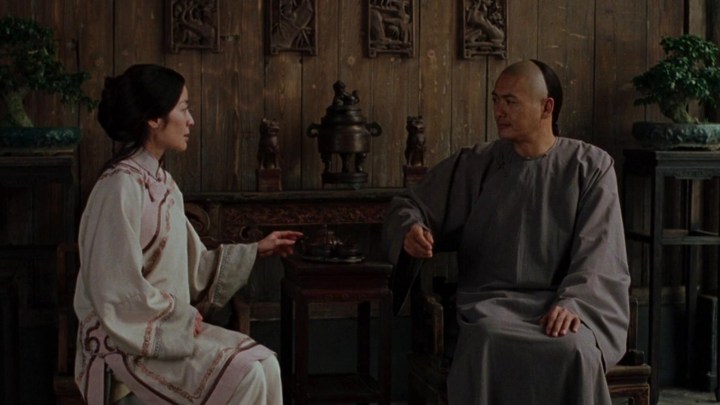
While searching for the sword, Shu Lien encounters a wide-eyed Jen (Ziyi Zhang), in their common friend, Sir Te’s house. Jen is the daughter of an aristocrat and is about to get married into a powerful family; an alliance seemingly well-suited for the political future on both sides. She is fluent at calligraphy and has all the mannerisms suited for such a life. But deep within, Jen feels trapped. She is enamored with Shu Lien and her warrior lifestyle and yearns for the freedom it may offer. The freedom to do what she wants, marry whoever she chooses and be free of the burden of expectations society has forced upon her appeals to Jen. But in her current situation, this seems like a far-fetched fantasy as even simple decisions like picking her own dress to managing her sleeping and waking hours are being taken by her governess. She seems destined for this bland life which has been laid out for her.
But behind this facade of a dull, aristocratic life lies a very different reality. Jen’s governess is actually Jade fox – Li Mu Bai’s nemesis who’s been living this secret life for years. We find out that after killing Li Mu Bai’s master, Jade Fox made her escape from the Wudang mountains and is in possession of the warriors’ secrets, which she stole on her way out. Having learned the fighting techniques herself, she also passed on her knowledge to her prodigy Jen. When Jen steals the ‘Green Destiny’ and lures Li Mu Bai out of his self-imposed exile, Jade Fox gets her chance to avenge her insult. Here, a little bit of back story helps us understand the spite between Jade Fox and Li Mu Bai. A once promising student of the martial art, Jade Fox had devoted herself to mastering the art form. But to her disillusionment, she learns that the traditional rules of Wudan clan prohibit a woman from becoming a master. As if to add insult to injury, Li Mu Bai’s teacher even sexually abused her without keeping his promises. She avenges this slight by killing the master and stealing the wudan secrets. Li Mu Bai is distraught because of this and vows to avenge his master’s death.
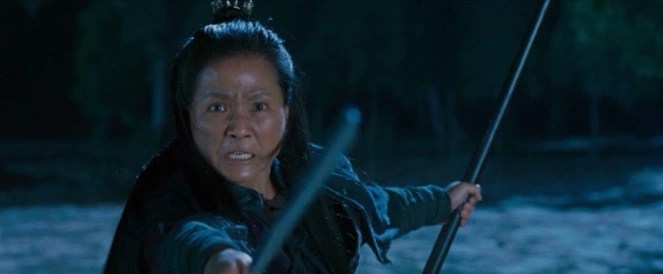
It is interesting to note that the central figure of the movie is Jen and not Li Mu Bai. Once it is revealed that the Jen is the thief (not too long into the movie), we get to see a whole new side of Jen’s character. She makes it very clear in her first encounter with Shu Lien that freedom is her core value. Unlike Jade Fox, Jen steals the ‘Green Destiny’ not because of its ties to Li Mu Bai or to see him defeated at the hands of her mentor. She does it for the thrill and to taste the freedom that it offers. This is an act of defiance that would be never allowed or tolerated in her household and it is exactly why she does it to prove her independence from her family. She is an extraordinary character who may seem impulsive at times, but upon closer observation, it is clear that her actions are driven by her will to be free. Also in order to make sense of the movie’s ending, it is essential to highlight Jen’s relationship dynamics with the people around her and understand her character in more detail.
Contrast between Li Mu Bai and Jade Fox
Let’s talk about the two figures who are in a mentor’s role in Jen’s life. Under the tutelage of Jade Fox, she becomes an excellent Wudan fighter and very soon her skills exceed that of her teacher. This is because, while the illiterate Jade Fox had to only rely on the illustrations, Jen mastered the intricacies described in the scrolls due to her reading abilities. At one point, she realizes that in order to further her talent, she may be better off learning from a Wudan master. This is where Li Mu Bai comes in. During their face-offs, Li Mu Bai offers to teach her himself and make an exception to recruit her to the Wudan school. On the face of it, he is exactly the mentor she is looking for. He can offer her what Jade Fox never could – to be formally taught the secrets of the elite Wudan warriors. Jade Fox was driven by revenge and was using Jen to fulfill her sole motive, which was to avenge her own insult. On the other hand, Li Mu Bai is the ideal mentor who has no selfish motives and can offer her a chance to excel at something she truly loves. The situation reminds me of how the young and immensely talented Anakin Skywalker and later his son Luke had to walk a fine line between good and bad in the Star Wars trilogies. The fact that Jen remains conflicted can be attributed to her core value. By accepting Li Mu Bai’s (or for that matter anyone else’s) offer, she risks forgoing her freedom and be bound to the training curriculum and her master’s will and potentially whims. Even with Jade Fox, she had fiercely guarded her independence. Secondly, there’s an almost poetic resemblance between her situation and that of Jade Fox where both of them were promised a place at the elite school. Jen is aware of how things turned out for Jade Fox and is hence wary of getting herself into this situation. Because of these possible reasons, she remains uncommitted to Li Mu Bai’s offer.
Contrast between Shu Lien and Jade Fox

The contrast between Shu Lien and Jade Fox is worth noting for different reasons. While Jade Fox represents anti-establishment views, and is generally against social protocols, Shu Lien represents order and restraint. Jade Fox’s worldview is shaped by her bitter experiences at the hands of establishment leaders which have only ended in disillusionment. Due to the injustice done to her, she takes great pleasure in breaking the set norms. One might say that she is free of the shackles of the society. But even then, Jen does not truly respect her. On the other hand, Shu Lien portrays a sense of calmness unless absolutely provoked. She is hesitant to go against the general flow and sticks to conventional way of life, even when it means suppressing her deep desires and feelings. In fact, she subtly indicates her feelings to Li Mu Bai by telling him that repressing one’s feelings can make them stronger. In that sense, even with her supposedly free-spirited warrior lifestyle, she is trapped in her own mind. The irony is that in spite of all this, Jen thinks of her as an elder sister. It is only when Jen is asked to go to Wudan mountains to meet her lover Lo, she senses a trap and turns against Shu Lien.
Jen’s relationship with Lo
We come to the final important character in Jen’s life – an outlaw bandit named Lo (Chang Chen) with whom she has a whirlwind romance in the deserts of the Western frontier. Lo and Jen meet when he raids the caravan in which Jen is traveling and fall in love. But Jen is aware of the difference in their societal status and she returns home only after Lo promises her that he will come to Peking to seek her hand. But later on when he actually comes to take her away, Jen refuses to go with him. A life on the move with a fierce bandit like Lo may seem perfect for someone who’s itching to break the norms her entire life. But Jen knows that Lo is a fiercely possessive man who doesn’t take no for an answer. She fears that by being with Lo, she will lose her independence and this is something that she can never come to terms with. So even with the knowledge of Lo’s genuine love for her, she refuses to elope with him.

*#*#* Spoilers Ahead *#*#* (Skip)
This brings us to the ambiguous ending of the movie. Why did Jen jump over the bridge and in to the mist?
Jen’s act is a recall to a legend told to her by Lo during their time together in the desert. In the legend, a man whose parents were ill, jumps off the mountain cliff. Since his heart was pure, his wish was granted, but he just flew away and was never seen again. In an echo of this tale, Jen is at a crossroads on the Wudang mountain after she reconnects with Lo. The thing that her heart most desires is freedom. Along with that, she also wants long lasting happiness for Lo. But in her mind, she knows that this idea is only a mirage and that these two things cannot coexist. I feel that the only person who could have persuaded her to stay on would be Li Mu Bai and not Lo. This is because, between Jen and Li Mu Bai, there’s an unsaid mutual respect and admiration. While everyone around Jen is afraid of her, Li Mu Bai is intrigued by her talent and offers to mentor her. But with Li Mu Bai’s passing, the last bond that could have tied her to this material world fades away.
As a result, she is faced with two hard choices. By choosing to stay with Lo, she will end up losing her freedom. On the other hand, if she rebuffs Lo’s proposal, he will never by happy knowing that he and Jen cannot be together for the rest of their lives. Just like the man in the legend, her intentions are pure, no matter how difficult it is for Lo to accept this fact. So in order to reconcile her heart’s wishes, she decides to jump off from the bridge. This way, no one can take her freedom away from her and Lo can move on from their relationship.
*#*#* End Spoilers *#*#*
Cast and Crew:
Chow Yun-Fat plays Li Mu Bai with a characteristic calm and charisma. This demeanor is well-suited to his character of a martial art master, who is almost always in control of his mind and body. An interesting side note – this role was originally offered to the action films legend Jet Li, but Chow Yun-Fat, who had never worked in a martial arts film before, ended up getting it. He mentions in one of the interviews that saying his dialogues precisely in between an intricately choreographed action sequence was a huge challenge for him. Mr. Yun-Fat’s hard work has indeed paid off and the scene is wonderfully executed.
Michelle Yeoh plays the warrior Shu Lien, a character who prides herself on not how many kills she’s had but the amount of restraint she can show in the face of a challenge. She considers herself as an elder sister to Jen and in spite of being fully aware of Jen’s intentions and actions, gives her every chance to come clean. Miss Yeoh is well known in Hollywood for her recent Oscar winning role in Everything Everywhere All At Once (2022) and that of Mameha in Memoirs Of A Geisha (2005) where she also shares the screen with her co-star Ziyi Zhang.
Finally, Ziyi Zhang plays the role of a headstrong, and at times conflicted, protagonist Jen to perfection. Jen is a nuanced character and Miss Zhang is equally impressive while portraying the sophistication and mannerisms of a girl raised in an aristocratic household and the angry fighter who, in a stunning action scene, destroys a large group of warriors in an inn. The audience can easily empathize with her character as it evolves throughout the movie.
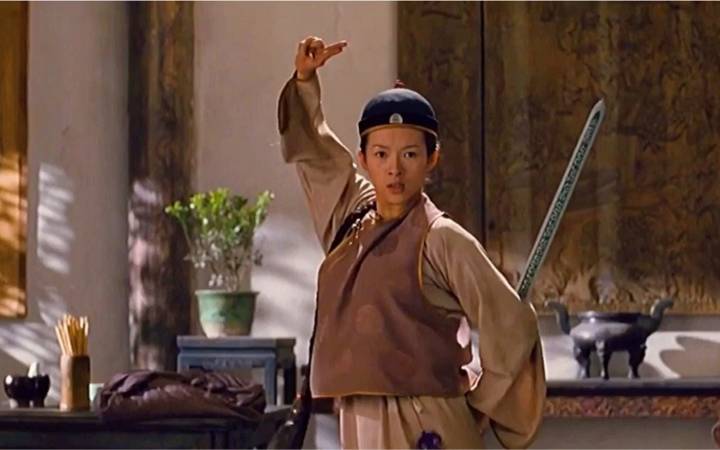
Cinematographer Peter Pau rightfully won the Academy Award for his effort on this movie. From the barren deserts of Mongolia, to the lush green bamboo forests and from the misty heights of Wudang mountain to the intricate palaces and houses of Peking, Mr. Pau’s cinematography brings each setting to life. The accompanying score of Dun Tan is haunting. With just the use of drum beats for action sequences and Yo Yo Ma‘s cello for setting the mood, Dan Tun manages to create a simple yet magical effect. This transports us to the location and the time in which this mythical film is set.
The true magic of this film lies in its famed action sequences. The characters were required to be flying and jumping across rooftops and on top of the bamboo forest. This is common in Wuxia style action films. Yuen Wo-Ping‘s action choreography and the use of wire-work technique is spectacular. He may be a relatively unknown name, but his stellar work on The Matrix (1999) remains permanently etched on the minds of all action fans. Pulling off these stunts requires precisely choreographed moves by all the actors and can be very dangerous. Many of these martial arts scenes are shot from the top giving us a great perspective of the action unfolding below. A couple of memorable actions sequences are the fight between Jen and Shu Lien and the one in the bamboo forest. Now armed with the knowledge that most of these scenes are done by the actors themselves without using any stunt doubles, my appreciation of these sequences has only grown with every repeat viewing of this movie. The only special effects deployed were to remove the wires from the shots, which were used to suspend the actors mid-air. Hats off to the entire crew for pulling this off so seamlessly!

Last but not the least, director Ang Lee’s story telling is at its finest here. Considering this is based on the fourth book of a pentology, it is very difficult to make the stand alone tale work without a lot of context for the audience. But right from the beginning, he does a fine job of establishing the characters and involving the audience in their stories. He tells us exactly how much we should know to make the movie work. As for the lack of specifics beyond mentioning that the story takes place during the Qing dynasty (1644-1912) Mr. Lee has said that he is taking us to a China of his own imagination. That is the reason why the film doesn’t go into more details related to time and place. He wanted to introduce the Wuxia style martial arts films to the western audience and had his eye on Hollywood while making the film. With top notch production values, and a cast and crew that supported his vision, his creation is nothing short of a masterpiece.
Final Thoughts:

Famous for its epic storytelling and memorable action sequences, Crouching Tiger, Hidden Dragon is a film to experience at least once. With its 4 wins at the 73rd Academy Awards for Best Foreign Language Film, Art Direction, Cinematography and Original Score, it is currently tied at the top for most Academy Awards won by a foreign film.
 Lights Camera Action
Leave a comment