
DIRECTOR
Federico Fellini
YEAR
1960
COUNTRY
🇮🇹
RUNTIME
174 min
STARRING
Marcello Mastroianni · Anita Ekberg · Anouk Aimée
GENRE
Drama
The Roman empire was arguably the greatest civilization in ancient history. At its peak, its territory stretched from Britain in the West to beyond modern day Turkey to the East and the entire Northern Africa. Rome’s military strength and engineering infrastructure was second to none. And yet, this mighty empire which had once vanquished great kingdoms in the past could not hold off against the attacks by smaller barbaric tribes and collapsed in a little over fifty years. In his six-volume magnum opus “The Decline & Fall Of The Roman Empire”, the influential British historian Edward Gibbons writes “Prosperity ripens the principle of decay”. He and many others have attributed this societal decline to the propensity of Rome’s wealthy elites of hoarding the taxes to fund their lavish lifestyles and ignoring the famed military and governance which had gotten them the wealth to begin with.
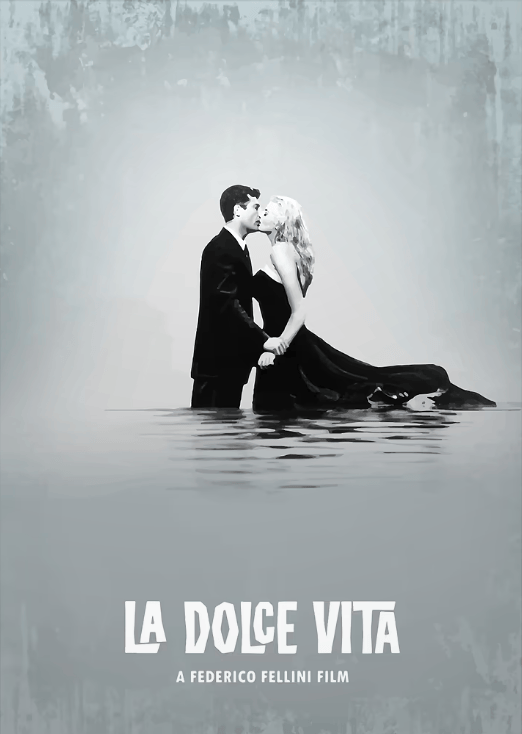
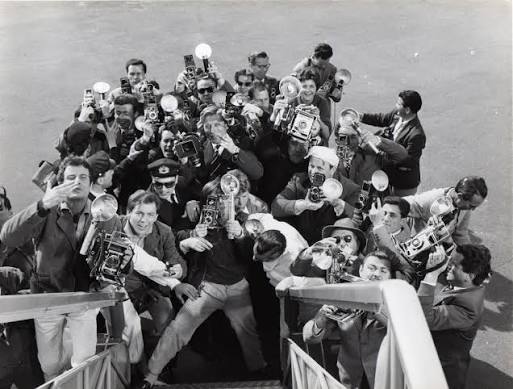
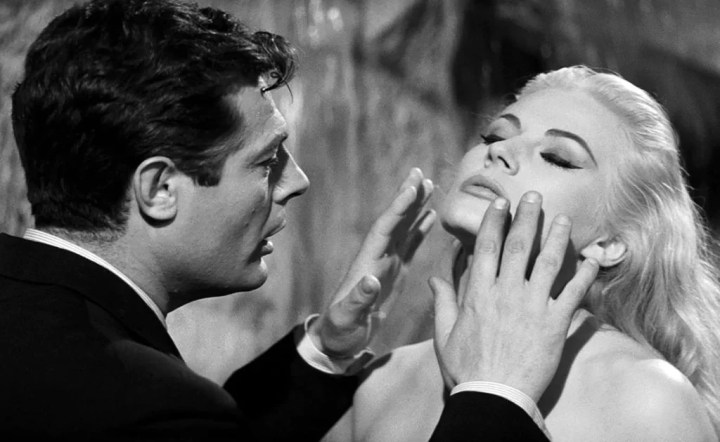
Federico Fellini‘s ‘La Dolce Vita’ (literally ‘The Sweet Life’) is a modern-day commentary in a similar vein on post-war Italy when it underwent rapid growth. The movie is set in and around Rome and is episodic in nature, in which we are treated to the decadent lifestyle of the rich and famous. We hop around from nightclubs to castles and soirée to orgies. Amidst the changing characters from one setting to another, the mad scramble of photographers and journalists to cover and report their every move remains constant.
Comments:
We are introduced to our protagonist Marcello in a helicopter, as he follows another that’s delivering the statue of Jesus Christ to the Pope. Marcello is a journalist who hobnobs with the wealthy and is always on the lookout for a scoop . We understand that at some point in his career, he aimed to be a serious writer but is now relegated to covering social events and parties along with his friend and sidekick Paparazzo. He is a serial womanizer who, when not covering the hot story of the day is trying to work through his relationship with his on-again, off-again girlfriend Emma.
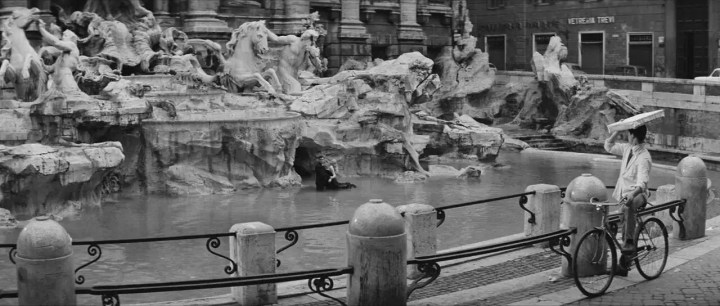
As we follow Marcello chase one story after another, we notice that a pattern emerges. Marcello flirts with women but is not serious about any of them. In turn, the high society people around him although seen enjoying the parties, are seldom happy. On the first night, he meets Maddalena, a wealthy heiress who is bored of her life in Rome and talks about running away and buying an island. As part of seeking thrill, they pick up a random prostitute who’s on her way home and have sex in her dilapidated house. The next day, he is on an assignment to cover the sensual Sylvia, a Swedish-American actress who’s just arrived in Italy to shoot her next film. Marcello shows her around the iconic places in Rome and the Vatican and is mesmerized by her beauty. In the evening, as Sylvia bursts into an impromptu dance at a dinner party, her drunk boyfriend sits around the table reading a newspaper. An argument ensues and Sylvia walks off to cool things down. Marcello accompanies her as they walk around the alleys of Rome through the night and end up wading in the Trevi fountain in the now iconic sequence.
The next scene stands out from the rest as it’s the only one which does not cover the rich. Marcello, Emma and Paparazzo visit the outskirts of Rome to cover the purported Madonna sighting in a field by two children. This scene gives us a good insight into the lives of the impoverished of the era. We understand that the whole ‘miracle’ is planned by the family of the children to attract media attention. Although debunked by the Catholic church, there is a huge public gathering of the believers and the curious and the event gets national coverage only to end in an unfortunate tragedy.
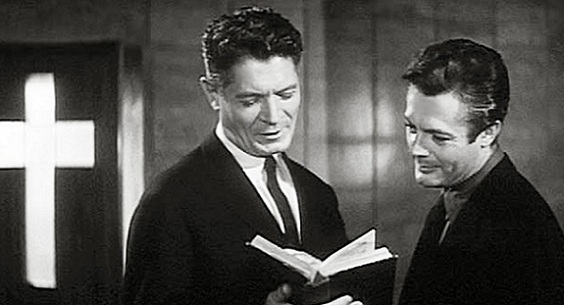
Amongst all of his acquaintances, there is only one person that Marcello can truly call a friend. Steiner is an intellectual person with whom we see Marcello being honest. After running into him at a church, Marcello gets invited to Steiner’s house for an evening of social gathering where he meets other poets, singers and writers. Marcello is impressed by the company and wishes his life was more like Steiner’s – someone who he thinks has achieved his potential and has a perfect family – a wife and two sweet children. In an intimate conversation, he admits to Steiner that he doesn’t like what he does and that he is hopeful for a future where he can practice an art which does not deceive or flatter – as he once tried with his writing. But Steiner offers a warning that nothing is as it seems as he himself feels trapped and fears losing sight of the ambitions he once harbored.
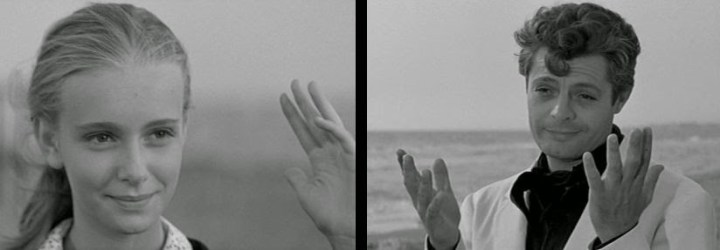
There are other memorable characters in the movie as well. Marcello’s father who is a traveling salesman makes an appearance and together with Paparazzo they visit the Cha-Cha club for a night out in the city. Marcello reminisces to Paparazzo about his childhood and expresses a regret that his father was never home and this evening would be a good chance for some father-son bonding. But due to some turn of events, Marcello ends up being disappointed, yet again. In another brief sequence midway through the movie (and at the end as well), he encounters a young girl named Paola at a cafe on a beach who he compares to an angel. She is the only other person who is not part of the ‘sweet life’.
Whether it’s the party at an aristocrat’s castle in Bassano di Sutri or at a beach house near Ostia, we are met with the same sight. Although living the lives many simply dream of, it’s as if the revelers are simply incapable of enjoying it. It’s the obscene excess that has killed the simple joys for them. We see people pretending to be asleep so as to avoid talking to others, destroying property for fun, and ghost-hunting in the middle of the night. A few are even surprised to find out that some of them have to work for a living. The moral decrepitude is on full display in the orgy scene where the partygoers deter a woman from performing a striptease because “everyone has seen her naked too often” and Marcello rides a woman horseback.
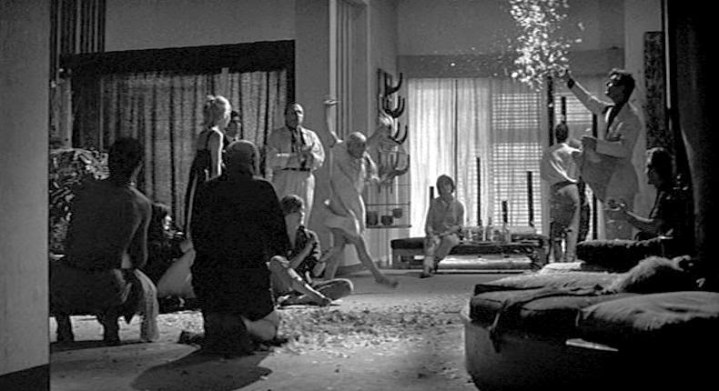
The message of the movie is clear. The wealthy are seemingly living the sweet life, a life of abundance where everything that one could wish for is there for taking. But this facade hides their burnt-out lives and shallow relationships. They are trapped in a vicious circle and struggle to find meaning in an otherwise empty existence.
The absence of a conventional plot is more than made up by the lengthy sequences – each one memorable in its own right as it adds a new dimension to the theme of the movie. It is hard to pick a favorite, but if I have to, I will go with the party at Bassano di Sutri where Marcello runs into Maddalena again. For me, this scene is the whole movie in a microcosm. We see the bored introductions, Marcello and Maddalena’s flirting and proposal inside the echo chamber, the ghost-hunting through the ruins on the castle grounds through the night followed by both spending the night separately with other people in the group. As dawn breaks and the tired group returns to the castle, they meet the princess mother haggling over the price of eggs on her way to the morning mass.
Cast and Crew:
Marcello is played by Marcello Mastroianni, one of Italy’s best actors of all time and one of my favorites. This was his first of five collaborations with Federico Fellini and they would both go on to make another highly successful and critically acclaimed film in 81/2 (1963). Other notable works of Mr. Mastroianni include La Notte (1961) and Divorce Italian Style (1961). The namesake character that Mr. Mastroianni plays in La Dolce Vita is complex and he captures the dreamer and the cynic in Marcello with equal finesse. Marcello had aspirations when he started out, and although he seems to be good at his journalist’s job, he has lost his way somewhere along the journey. He seems to care about Emma, and even Maddalena, but is scared of commitment. Just like the characters of Seinfeld, Marcello never grows up. I was hoping and waiting for his redemption that never came.
The cinematography of Otello Martelli is absolutely stunning. The rare choice of shooting this black & white movie in a widescreen format is interesting because it helps to add distance between its characters and the audience. Several iconic shots from the statue of Jesus flying over Rome to the echo chamber linger in mind. My absolute favorite was the iconic Trevi fountain scene. When Marcello enters the fountain and approaches Sylvia we see their close ups. This is because nothing else matters to him as he stands besides the woman of his dreams. But as dawn breaks, we see the wide shot of the fountain indicating that the dream moment is over. It is quite possibly the best looking black & white movie I have ever seen.
Mr. Fellini’s glorious career can be split into two halves. The first half overlapped with the Italian neorealism film movement that focussed on the pain and struggles of the poor, working class people in post-war Italy. I Vitelloni (1953), La Strada (1954) and Nights of Cabiria (1957) were some of his masterpieces from this era. The second half was more abstract and extravagant – 81/2, Amarcord (1973) to name a few. La Dolce Vita sits right in the middle of these two phases and it’s a perfect mix of both. There is plenty of symbolism in this movie and one will require multiple viewings to grasp most of it. At the time of release, the film’s theme caused a big uproar in the conservative society. The Catholic church was shaken over promiscuity, homosexuality, and divorce being glamorized in films. There was a strong push to ban this movie to prevent any further moral decay. But as expected, the result was exactly the opposite and this whole ruckus played into raising the film’s publicity.
Final Thoughts:
Strange as it may seem, this movie reminded me of the Pixar animated classic Wall-E (2008). Across cultures and civilizations, the same tenets hold true. Societies are constantly evolving and when the focus shifts from core values and morals to seeking external pleasures, it becomes a catalyst for their eventual downfall. Through this unconventional, allegorical and above all memorable film, Mr. Fellini warns us about the futility of chasing the sweet life. An absolute must-see masterpiece.


Leave a Reply